

Padel Shots, Tactics, and Positioning
Padel has a core set of about a dozen shots, grouped as groundstrokes, volleys, lobs, overheads, wall shots and soft shots, and which one to use depends mostly on where the player is standing. Near the net the choices are volleys and overheads that attack, while from the back of the court they are lobs, wall returns and soft shots that rebuild the point and win the net back.
- The core shots fall into six groups: groundstrokes, volleys, lobs, overheads, wall shots and soft shots.
- The serve, lob, forehand, backhand, volley and wall return come first for a beginner, and the vibora and bajada can wait.
- Win the net and move with a partner: in professional finals, smashes won more points the closer to the net they were hit, and the lob and the chiquita are the two shots that take the net back.
What Shots Do You Need to Know in Padel?
A padel player’s toolkit comes to roughly a dozen shots. The underarm serve and the forehand and backhand groundstrokes start and sustain a rally, the volley and the lob handle balls in the air, and three overheads, the bandeja, the vibora and the smash, answer high balls. The walls add two shots with no tennis equivalent, the basic wall return and the bajada, and the chiquita, a soft shot, changes the pace of a point rather than its power.
Most of these keep their Spanish names in English-speaking clubs, because the sport developed in Spanish-speaking countries and the vocabulary came with it. Bandeja means tray, vibora means viper, chiquita means little one, bajada means descent, globo is the lob and remate is the smash. The Spanish j in bandeja and bajada sounds like an English h, which gives ban-DEH-ha and ba-HA-da.
Position decides which of those shots is available at any moment. A player at the net chooses among volleys and overheads, and a player at the back chooses among lobs, wall returns, bajadas and chiquitas. Match data shows how much of the attacking work is volleying: a 2020 analysis recorded 2,054 shot-by-shot actions in four men’s World Padel Tour finals from 2017, and among the attacking strokes volleys made up about 65 percent, bandejas about 23 percent and smashes about 12 percent, with 80 percent of points settled in fewer than three attacking actions.
Which Padel Shots Should Beginners Learn First?
The serve comes first, since every point begins with one. Under the FIP Rules of Padel, Review of application 01.01.2026, the server stands with one foot behind the service line, bounces the ball, strikes it at or below waist level and sends it diagonally over the net into the opposite service box. A first serve that fails earns a second attempt, and a player who misses both loses the point.
Bounce’s padel shots guide advises learning the serve, lob, forehand, backhand, volley and wall return before spending much time on the vibora or bajada, and it singles out the lob as the most useful shot for early improvement. It names the bandeja as the first overhead to teach most beginners after those basics. Forehand and backhand groundstrokes keep a rally going, and the volley, struck before the ball bounces, is the net shot. Padel Browser’s glossary notes that padel volleys are usually blocked or punched short rather than driven.
The lob gives a beginner time and can take the net away from an opposing pair. Padel Browser’s glossary describes the globo as a defensive shot when a player is pinned at the baseline and needs time, and as an offensive one that pushes the net pair off their position. The authors of the professional smash study read high, deep lobs the same way, as a way to force attackers to hit from far from the net.
The wall return is the first shot with no tennis equivalent. Under FIP’s Rule 12, a ball that has bounced on the receiving side and then hits the walls or the mesh stays in play, and it only has to be returned before its second floor bounce. In practice that means a player can let the ball come off the glass and then play it back over the net.
How Do Padel’s Overhead Shots Differ?
Padel has three main overhead shots, and the difference between them is how much risk a player takes with a high ball. Padel Browser’s glossary describes the bandeja as a slice overhead hit from mid-court and used to hold the net without committing to a full smash. The vibora is a sliced, sidespin overhead of similar shape but more aggressive, with the ball snaking away from the receiver after the bounce. The smash, or remate, is the full-power overhead used when a player has a high ball at the net and wants to end the point.
Professional data puts numbers on those choices. A 2020 study in the International Journal of Environmental Research and Public Health analyzed 1,015 smashes from eight 2019 World Padel Tour finals, four men’s and four women’s, and sorted them into four types: tray, flat, topspin and off the wall. The tray is the bandeja, so the study treats it as a kind of smash, and it was the most used type. Dividing the study’s own counts, the tray made up about 56 percent of the men’s smashes and about 69 percent of the women’s.
The tray also kept the point alive 89.7 percent of the time for men and 87.0 percent for women, with winners on 7.2 and 6.8 percent of attempts and errors on 3.1 and 6.2 percent. The flat and topspin smashes produced the most winners: 51.8 percent of the men’s flat smashes and 41.2 percent of their topspin smashes ended the point, against 33.3 and 29.2 percent for the women, though both types lost effectiveness as players hit from farther from the net, especially the flat smash.
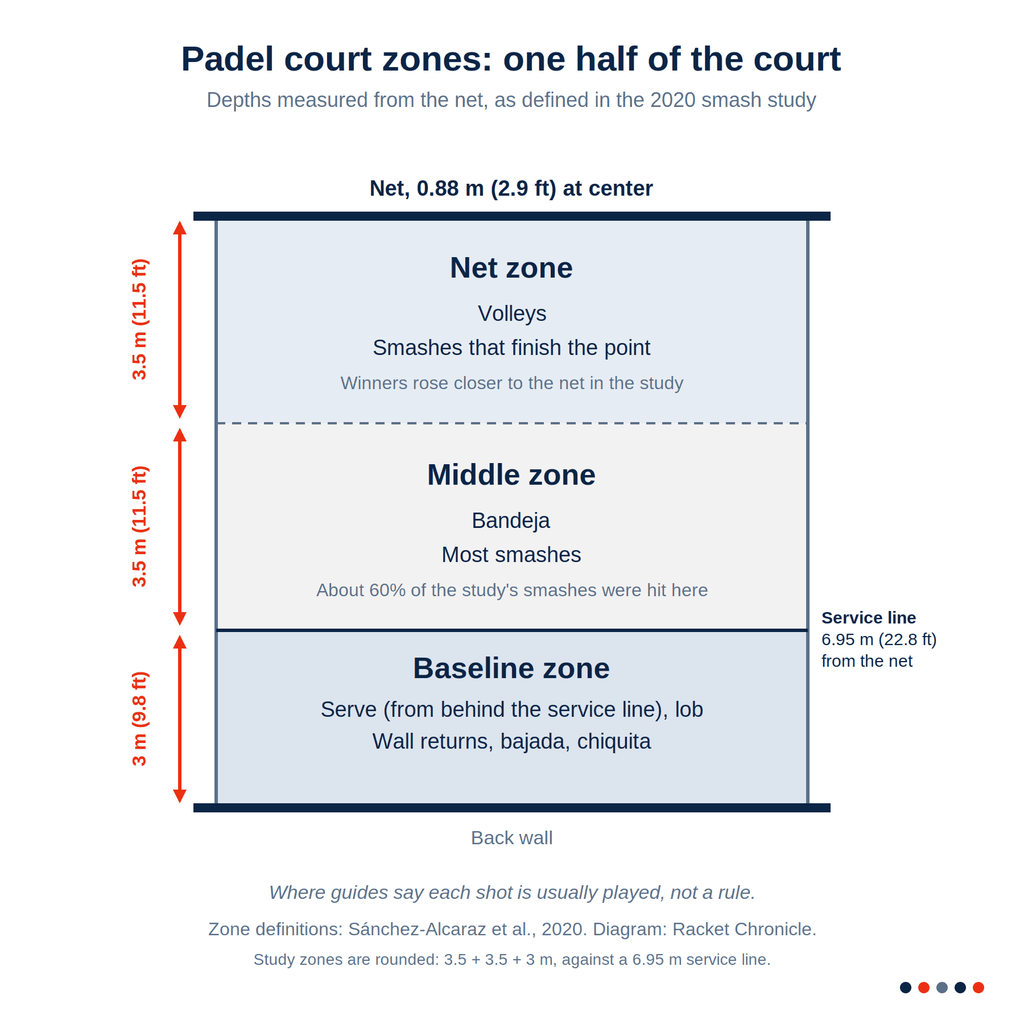
Two limits apply to those figures. The study’s four categories do not include the vibora, so none of the numbers describe it, and the sample is eight professional finals, so it describes elite play; the authors also note that opponent position and smash speed were not measured. Roughly 60 percent of all the smashes came from the middle zone, and the authors read that as defenders using high, deep lobs to force attackers to hit from positions far from the net.
How Do You Play Shots Off the Back Wall in Padel?
The bajada is the attacking version of the wall return. The ball bounces on the player’s side, rebounds off the back glass, and the player strikes it after the rebound. Sources disagree on how aggressive the shot should be: Padel Browser’s glossary calls it a controlled overhead hit down and forward with pace taken off so the partners can reset at the net, less aggressive than a smash and more aggressive than a bandeja, while Bounce’s guide lists it as the shot for attacking a high ball after it rebounds from the back glass.
The closest category in professional data is the study’s off-the-wall smash: an overhead struck after a lob has bounced on the hitter’s side and rebounded off the back wall, played either flat or with slice. It had the highest error rate of the four smash types, 7.3 percent for men and 15.2 percent for women, and it kept the point going 75.6 percent of the time for men and 69.6 percent for women, with winners on 17.1 and 15.2 percent of attempts. The study does not call that category a bajada, and the two should not be treated as the same shot, but the numbers show how risky an overhead taken off the back wall is even for professionals.
What Are the Soft Shots in Padel?
A chiquita is a low, soft ball hit at the feet of the net players to force them to lift the ball back up. Padel Browser’s glossary calls it the classic way for defenders to neutralize a strong net pair without lobbing. The Padel School lists it alongside the lob as a way to get to the net after a return: a pair that hits a lob, or a chiquita down to the opponents’ feet, can move forward together behind it.
The lob is the soft shot with the clearest defensive job. Bounce’s guide calls it the shot that resets the court, and Padel Browser’s glossary describes the defensive position as one that lobs and plays chiquitas to bring the opponents off the net. Hit high and deep over the net players, it forces them back, takes away their position and gives the lobbing pair time to move forward.
Where Should You Stand in Padel?
Padel has two basic positions, the offensive one near the net and the defensive one near the back wall. The smash study’s authors describe the point as a continuing contest in which the net pair try to keep their position and the backcourt pair try to recover it. Padel Browser’s glossary calls the net position the dominant one in padel, and the three meters in front of the net the space whose ownership decides most points.
The study divides each half of the court into three bands measured from the net: a net zone 3.5 meters (11.5 feet) deep, a middle zone 3.5 meters (11.5 feet) deep and a baseline zone 3 meters (9.8 feet) deep that runs from the service line to the back wall. These are the researchers’ divisions, not FIP terms. They sit on fixed court geometry: the service line is 6.95 meters (22.8 feet) from the net, where the baseline zone begins, and the net stands 0.88 meters (2.9 feet) high at the center.
Positioning in padel belongs to the pair rather than the individual. The Padel School’s guide to moving as a pair explains why: if one partner stays back while the other moves in, a large gap opens on the diagonal through the middle of the court, and moving together closes that space and leaves only small gaps in the center.
Pairs advance behind a good shot. The Padel School names a lob, or a chiquita down to the opponents’ feet, as the shots to move forward behind. It adds that when a net pair face a lob that does not push them all the way back, one partner can step back, hit a bandeja and sprint back to the net.
What Tactics Win Points in Padel?
Nearly every tactic in padel serves one aim, winning the net and keeping it. The Padel School calls getting to the net and staying there one of the major objectives of the game, and the match data agree. In the 2017 men’s finals analysis, volleys were the most used attacking stroke and 80 percent of points were settled in fewer than three attacking actions, and in the smash study winners rose significantly as hitters moved closer to the net, especially with flat and topspin smashes.
Retaking the net relies on two shots, the lob and the chiquita, and Padel Browser’s glossary ties both to the defending pair’s job of bringing the opponents off the net. Once a pair holds the net, the same glossary says most points are won by attacking the middle, where neither opponent has clear authority. The Padel School adds that shots down the middle are tricky, and that partners need to agree who plays them, usually but not always the forehand player.
Varying direction is the other principle the data supports. The study’s authors describe alternating down-the-line and cross-court smashes as a way to make opponents move from one side of the court to the other and hit from less comfortable positions, and the professional sample did vary them: trays were split almost evenly between the two directions, while flat and off-the-wall smashes went mostly down the line.
Padel Shots FAQs
What is a bajada in padel?
A bajada is an attacking shot played after the ball has bounced on a player’s side and rebounded off the back glass, struck from the back of the court to turn a wall rebound into pressure or a reset. The word is Spanish for descent. Sources disagree on how aggressive it should be, with Padel Browser’s glossary describing a controlled overhead hit with pace taken off and Bounce’s guide listing it as the shot for attacking a high ball after the rebound.
What is a chiquita in padel?
A chiquita is a low, soft ball hit at the feet of the net players. The name is Spanish for little one. It forces the net players to lift their volley instead of hitting down, which Padel Browser’s glossary describes as the classic way for defenders to neutralize a strong net pair without lobbing.
What is the difference between a bajada and a bandeja?
A bandeja is an overhead struck out of the air, without a bounce, with slice, usually from mid-court, to hold the net. A bajada is struck after the ball has bounced on the hitter’s side and rebounded off the back glass, from the back of the court. In the professional smash study the tray, which is the bandeja, kept the point alive 87.0 to 89.7 percent of the time, while the closest category to a bajada, the off-the-wall smash, had the highest error rate of the four types.
Which padel shot should a beginner learn first?
The underarm serve, because every point begins with it and a player who misses two in a row loses the point. After that, Bounce’s guide recommends the lob, forehand, backhand, volley and wall return, which give a new player enough to rally, hold the net and recover a ball that goes past them. The guide adds the bandeja once a player can move into position early and contact overhead balls with control, and the vibora and bajada can wait until those hold up.
How do you improve at padel?
Improvement comes mostly from positioning and shot choice rather than power. In professional finals 80 percent of points were settled in fewer than three attacking actions, and in the smash study winners rose as hitters moved closer to the net, so getting to the net together and picking the right overhead counts for more than hitting any shot harder. Bounce’s guide singles out the lob as the most useful shot for early improvement, which makes it the one worth rehearsing first.
Sources
International Padel Federation, “Rules of Padel,” Review of application 01.01.2026
Padel Browser, “Padel Glossary: 50+ Essential Terms Every Player Should Know,” June 2026
The Padel School, “Moving As A Pair,” accessed October 2026
Bounce, “Padel Shots Guide: Techniques, Tips & When to Use Them,” July 2026
Image: Depositphotos
