

Smash Padel: How to Hit a Padel Smash
The smash is padel’s full-power overhead, hit from above head height at the net to finish a point, and Spanish-speaking clubs call it the remate. Padel’s walls change when it is worth hitting: a hard, flat ball that clears the opponent can rebound off the back glass and stay in play.
- The smash is the one overhead aimed at ending the point; the bandeja and the vibora play the same position with less risk.
- Turn sideways early with the free hand up, then meet the ball high and in front of the hitting shoulder.
- A smash that bounces and then goes over the end wall wins the point; over a side wall it wins the point unless the venue allows out-of-court play, where the receiving side can still return it.
What Does the Smash Do in Padel?
Padel is played in doubles on a fully enclosed court with glass and mesh walls, and those walls keep a hit ball moving after it bounces. The smash is one of the three main overheads, and the only one aimed at ending the point outright. The bandeja holds the net without committing to a full smash, and the vibora trades some raw pace for sidespin and placement.
A smash is struck above head height with a full swing, usually at the net, against a lob that has not gone deep. Remate is the Spanish name. Two finishes that coaches call the por tres and the por cuatro are covered in the rules section below.
How Do You Hit a Padel Smash?
The sources agree on the setup. Bounce says to turn sideways early and Padel Browser says to rotate as soon as the lob goes up, and Nox, writing about the por tres, also starts from a sideways stance. Bounce and Padel Browser add that the non-hitting hand stays up and points at the ball. Padel Browser says to cover the ground with a crossover step instead of a backpedal, with a split step as the opponent hits the lob. Nox advises pushing off the feet and striking at the highest possible point on the por tres. Bounce does not mention jumping, so it is one coach’s advice for one variation.
Grip is where coaches split. Padel Browser says continental, the same as the volley grip. Bounce says most intermediate and advanced players use a continental or slight eastern grip, and warns that a heavy western grip flattens the ball. Babolat names the hammer, or continental, grip as the foundation for most padel shots, while All For Padel advises a backhand grip on the por tres to add spin. Contact point splits in emphasis. Bounce puts contact 15 to 20 cm (6 to 8 in) in front of the hitting shoulder at full extension, and Padel Browser also says to make contact in front. Nox and Babolat stress the highest point, and All For Padel advises a slightly later point of impact on the por tres on a shot played from further back.
On the swing, Bounce describes power chaining from the legs through the torso and shoulder to the forearm. Padel Browser says the flat smash snaps the wrist forward with a flat racket face, and the topspin smash brushes up and through the ball. Nox finishes the por tres on the side of the hip opposite the hitting arm. Padel Browser says to sprint back to the net after every smash, and Bounce says to step forward after a weak reply or reset toward center if the opponents defend it.
The Padel School’s article “Why The Tennis Smash Doesn’t Work in Padel” argues that the tennis smash does not transfer: padel rackets do not generate the same power, the walls keep the ball in play, and one poorly executed shot can turn attack into defense. It adds that skilled opponents wait for the ball to come off the wall, and that a player should keep the hard smash for the net when the point is sure to end. LTA Padel describes the traditional tennis smash as hit flat with plenty of speed and power. Few other sources spell out the difference; Babolat says only that the padel smash differs from tennis.
What Types of Smash Are There in Padel?
A 2020 study of professional smashes by Sánchez-Alcaraz and colleagues sorted 1,015 smashes from eight 2019 World Padel Tour finals into four types: tray, flat, topspin and off the wall. It defines the flat smash as an overhead hit without a bounce, with power and no spin. Bounce describes it as driving the ball into the opponent’s court with minimal topspin, working best above head height from inside the service box or close to the net. Padel Browser says to aim for a sharp downward bounce that clears the back glass.
A flat smash does not always end the point. In the study, the opponent kept the point going against 43.9 percent of the men’s flat smashes and 63.1 percent of the women’s, the only sex difference in efficacy that reached statistical significance (p = 0.020). The tray, which is the bandeja, kept the point going 89.7 percent of the time for men and 87.0 percent for women.
The topspin smash, which Bounce and Padel Browser also call the kick smash, trades pace for bounce. Bounce says the topspin makes the ball jump high after the bounce and back-wall contact. Padel Browser says it lands near the back service line and kicks above shoulder height, which forces the opponent to play a defensive bandeja while moving backward. The study’s fourth type, the off-the-wall smash, is hit after the ball has bounced and come off the back wall.
What Do the Rules Say About a Smash That Leaves the Court?
The Rules of Padel, in the International Padel Federation’s review of application dated January 1, 2026, count the inside of the walls, the metallic mesh fence, the ground, the net and the net posts as parts of the court (Rule 12.4). A ball that hits any part of the court after bouncing on the opponent’s ground stays in play and must be returned before its second bounce (Rule 12.3). A smash is a correct return when it bounces directly into the opponent’s court, or hits the hitter’s own wall first and then bounces there (Rule 14 b), and when it bounces in the opponent’s court and then hits the fence or a wall (Rule 14 c). It loses the point if, without a bounce, it hits the opponent’s walls, the metallic fence or an unrelated element (Rule 13 g); if it hits the net or a post and then the opponent’s walls, the fence or an unrelated element (Rule 13 h); or if, once hit, it touches the metallic fence or any part of the hitter’s own ground (Rule 13 l).
A smash that bounces correctly and then leaves the court is also a correct return, as is one that bounces and then hits the ceiling, the lights or another object unrelated to the court (Rule 14 d). What follows depends on whether the venue authorizes out-of-court play. Where it does not, a ball that bounces and then crosses the outer perimeter over the end or side walls, or goes through the gate, costs the side meant to return it the point (Rule 13 d). Where it does, a ball that bounces correctly and goes over the end wall costs that side the point at once, but one that goes over a side wall or through a door stays live: the receiving side loses the point only when the ball bounces a second time or touches an unrelated element (Rule 13 e), and a return struck from outside the court is valid if the other conditions of Rule 14 are met (Rule 14 j). The point goes to the hitter if the ball bounces and then goes out through a hole in the fence or lodges in it, or lodges on the flat top of a wall (Rule 15 a and b).
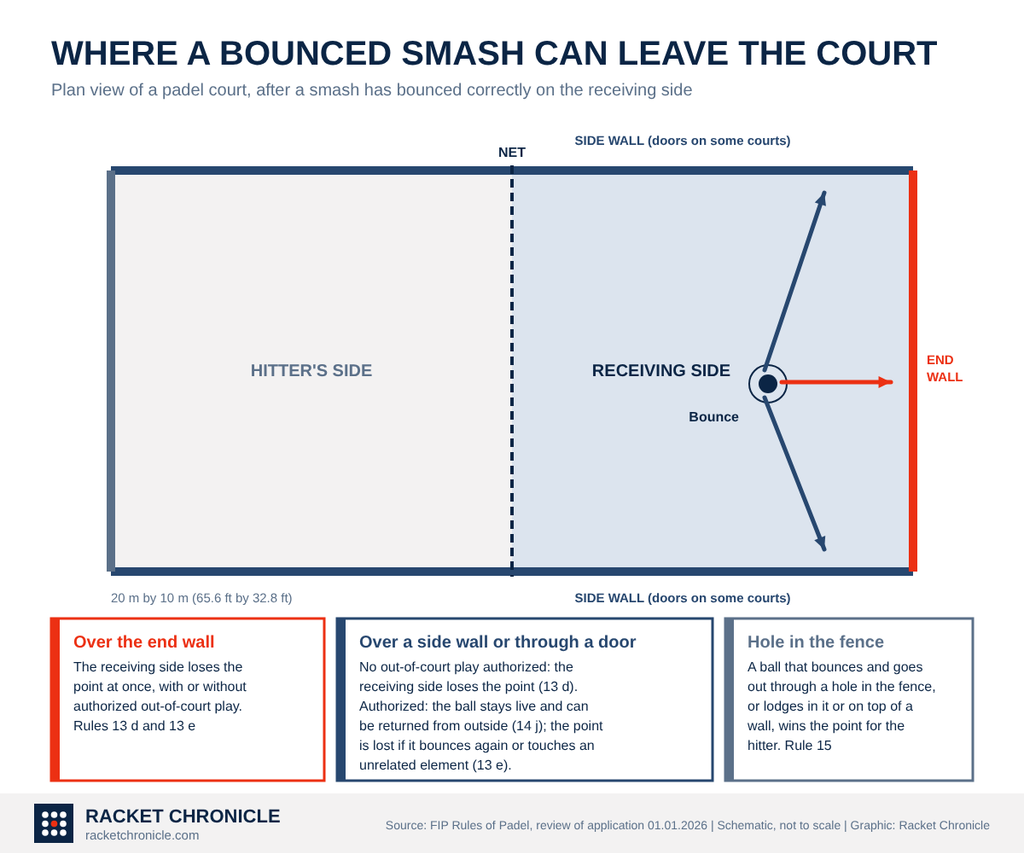
Rule 16 authorizes players to leave the court to play the ball only where the court meets the rulebook’s conditions for the safety area and out-of-court play. Those include two access points on each side and an area outside the court free of obstacles at least 3 m (9.8 ft) wide (4 m recommended), 4 m (13.1 ft) long and 3 m (9.8 ft) high.
The rulebook uses neither por tres nor por cuatro, nor the x3 and x4 shorthand; it describes the situations in the rules above. Coaches use the names and disagree on them. Nox and Bounce describe the por tres as a smash that bounces and exits over the 3 m (9.8 ft) side wall, and All For Padel describes the x3 as getting the ball out of the court from the side. Padel Browser instead has the x3 clearing the back glass into the mesh behind it and the x4 clearing the back glass and leaving the playing area. Whether a given shot wins the point turns on where it exits and on whether the venue authorizes out-of-court play, so the rulebook, not the label, decides.
When Should You Smash, and When Should You Hold Back?
Padel Browser’s rule of thumb is to smash when the lob is short and the ball can be hit above the shoulder while moving forward. The Padel School’s guide “The Padel Smash” says hitting as hard as possible is not always best: opponents who let the ball come off the glass can win the point, and many players reach for the smash when they do not know how to hit a bandeja.
The vibora is the middle option, a sliced overhead with sidespin that is safer than a full smash. A hard, flat ball that clears the opponent can still come back into play off the back glass, which is the risk of the full smash. Babolat says the bandeja is played on moderately high lobs when a smash would be too risky.
Smash Padel FAQs
What is a smash in padel?
The smash is padel’s full-power overhead, hit above head height, usually at the net, to finish the point. Spanish-speaking clubs call it the remate. It is one of three main overheads, alongside the bandeja and the vibora, and the walls decide how safe it is to hit hard.
How is a padel smash different from a tennis smash?
The Padel School argues that the tennis smash does not transfer: padel rackets do not generate the same power, the walls keep the ball in play, and one poorly executed shot can turn attack into defense. A padel point does not always end when the ball clears the opponent, as a hard, flat ball can rebound off the back glass and stay in play. LTA Padel describes the traditional tennis smash as hit flat with plenty of speed and power.
Can you win a point by smashing the ball out of the court in padel?
Yes, in defined cases. Under the International Padel Federation’s rules, a smash that bounces in the opponent’s court and then goes over the end wall wins the point. Over a side wall or through a door it wins the point where out-of-court play is not authorized; where it is authorized, the receiving side can follow the ball outside and return it, and loses the point only if the ball bounces a second time or touches an unrelated element first. Coaches call these finishes the por tres and por cuatro, and the rulebook uses neither name.
What is a kick smash in padel?
A kick smash is a smash hit with topspin so the ball jumps high after it bounces. Bounce says the topspin makes the ball jump after the bounce and back-wall contact, and Padel Browser says it lands near the back service line and kicks above shoulder height. Padel Browser adds that this forces the opponent to play a defensive bandeja while moving backward.
How often do professional players hit a smash instead of a bandeja?
An analysis of four men’s World Padel Tour finals from 2017 (n = 2,054 attacking actions) found about 65 percent volleys, 23 percent bandejas and 12 percent smashes. The 2020 smash study counts the tray, which is the bandeja, as one of its four smash types, and it was the most used type across eight 2019 finals. Both samples are elite finals, so they show what professionals do, not what every player should do.
Sources
International Padel Federation, “Rules of Padel,” Review of application 01.01.2026
The Padel School, “Why The Tennis Smash Doesn’t Work in Padel”
