

Padel is a racket sport played in doubles on a fully enclosed court, small enough that roughly three padel courts fit in the space needed for one regulation tennis court. The surrounding glass and mesh walls are part of the game, the same way walls are part of squash, and the ball stays live off them after it bounces on the court floor.
- Padel combines tennis scoring with squash-style wall play on a small, fully enclosed court, and it is always doubles.
- The International Padel Federation counted about 35 million amateur players worldwide as of 2026, though the Playtomic and PwC Strategy& 2026 Global Padel Report puts the figure closer to 19.4 million using a more conservative, usage-based method.
- Padel uses a solid, stringless racket and an underarm serve, setting it apart from strung-racket tennis and from pickleball's smaller, wall-free court.
What Is Padel?
Padel is a doubles-only racket sport played on an enclosed court, where the ball can be returned off the surrounding glass and mesh walls after it bounces on the court floor. It borrows its scoring system directly from tennis: points run 15, 30, 40, game, with sets played to six games and matches decided over the best of three sets. What sets padel apart is the equipment and the court itself. Rackets are solid, built from composite material over a foam core, with no strings; the hitting surface is perforated with small cylindrical holes rather than crosshatched with string. The ball looks like a tennis ball but carries less internal pressure, so it sits lower and softer off the racket.
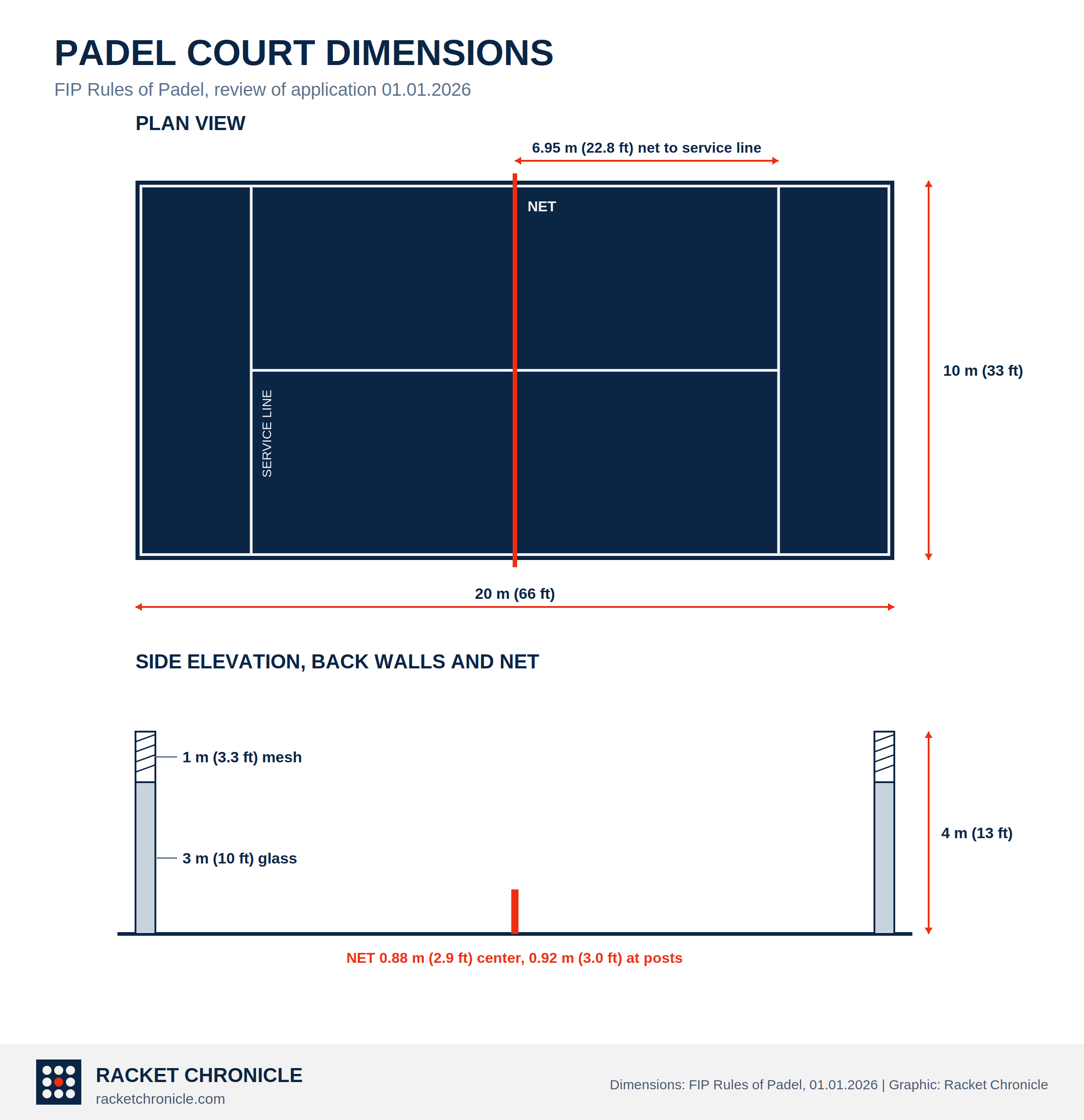
A regulation padel court measures 20 meters long and 10 meters wide (about 66 by 33 feet) under the International Padel Federation's current rules. A net divides the court into two equal halves, set 0.88 meters (2.9 feet) high at the center and 0.92 meters (3.0 feet) at the posts. The court is fully enclosed: the back walls run about 4 meters (13 feet) high, typically 3 meters (10 feet) of solid glass topped with a meter (3 feet) of metal mesh, with the side walls stepping down toward the net. Because the walls are part of live play, a shot that would go out in tennis can still be returned in padel, as long as it clears the net first and stays inside the enclosure.
Every padel match is doubles. There is no official singles format at professional or federation level, and the compact, enclosed court keeps rallies close and fast rather than built around covering open space. The underarm serve, struck at or below waist level, keeps the opening of each point lower-risk than a tennis serve, and most of the scoring drama plays out in exchanges near the net rather than off big serves.
How Is Padel Played?
A padel match starts with a coin toss or paddle spin to decide serve and side, then follows the same structural rhythm as tennis: games, sets, and a match. The server stands behind the baseline, bounces the ball once, and strikes it underarm at or below waist level into the diagonal service box on the other side of the net. From there, the ball is live off the walls under FIP's rule that a return stays in play if it touches any part of the court, including the walls and fence, after first bouncing on the correct side. A point ends when the ball bounces twice on the floor, goes out through one of the mesh exit gaps, or a player commits a fault.
Rallies tend to run longer than in tennis because the walls keep points alive that would otherwise end. Players use the back and side walls defensively, letting a hard-hit ball rebound off the glass before returning it, and offensively, aiming shots that clip a wall on the way out to make them harder to reach. FIP's current rulebook sets specific fault and let rules for exactly when and how a wall touch counts, detailed in full on the padel rules page.
Where Did Padel Start?
Padel was invented in 1969 by Enrique Corcuera at his home, Las Brisas, in Acapulco, Mexico, according to the International Padel Federation's official history. Corcuera wanted a tennis court in his backyard but did not have the space, so he built a smaller one instead, 20 by 10 meters, and enclosed it with 3-meter walls to keep the ball from constantly disappearing into the neighboring garden. His wife, Viviana, a former Miss Argentina, wrote the first set of rules as a birthday gift.
The sport reached Spain in the early 1970s when Prince Alfonso of Hohenlohe, a friend of Corcuera's who spent summers at Las Brisas, built the first European courts at the Marbella Club Hotel in Andalusia. Around the same time, Julio Menditeguy, an Argentine member of the same tennis club circle, introduced padel to Argentina, where early courts went up at Club Tortugas and the Mar del Plata Ocean Club. Spain and Argentina remain the sport's two heartlands, and both were founding members, alongside Uruguay, when the International Padel Federation was established in Madrid on 12 July 1991.
How Popular Is Padel?
Padel's exact global player count depends on who is counting and how. The International Padel Federation put the number at approximately 35 million amateur players worldwide as of 2026, spread across more than 150 countries and 100 affiliated national federations. The Playtomic and PwC Strategy& 2026 Global Padel Report, published in May 2026 and built from a bottom-up count of courts, clubs, and usage rates rather than federation membership, arrives at a more conservative 19.4 million players, alongside roughly 20,900 clubs and 58,300 courts worldwide. Both figures are defensible on their own terms: FIP's count leans on federated and estimated recreational participation, while Playtomic's leans on measured court usage, and the gap between them is a reminder that padel does not yet have one agreed census.
Spain and Argentina remain the sport's heartlands by both player numbers and professional talent; of the players occupying the top ranking spots on the FIP world rankings in August 2026, the large majority carry Spanish or Argentine passports. Growth is concentrated elsewhere now. The Middle East has become a significant investment and tournament market, and Playtomic's 2026 report singles out the United States as one of the sport's biggest long-term growth opportunities, describing it as a market still early in its development but carrying substantial upside.
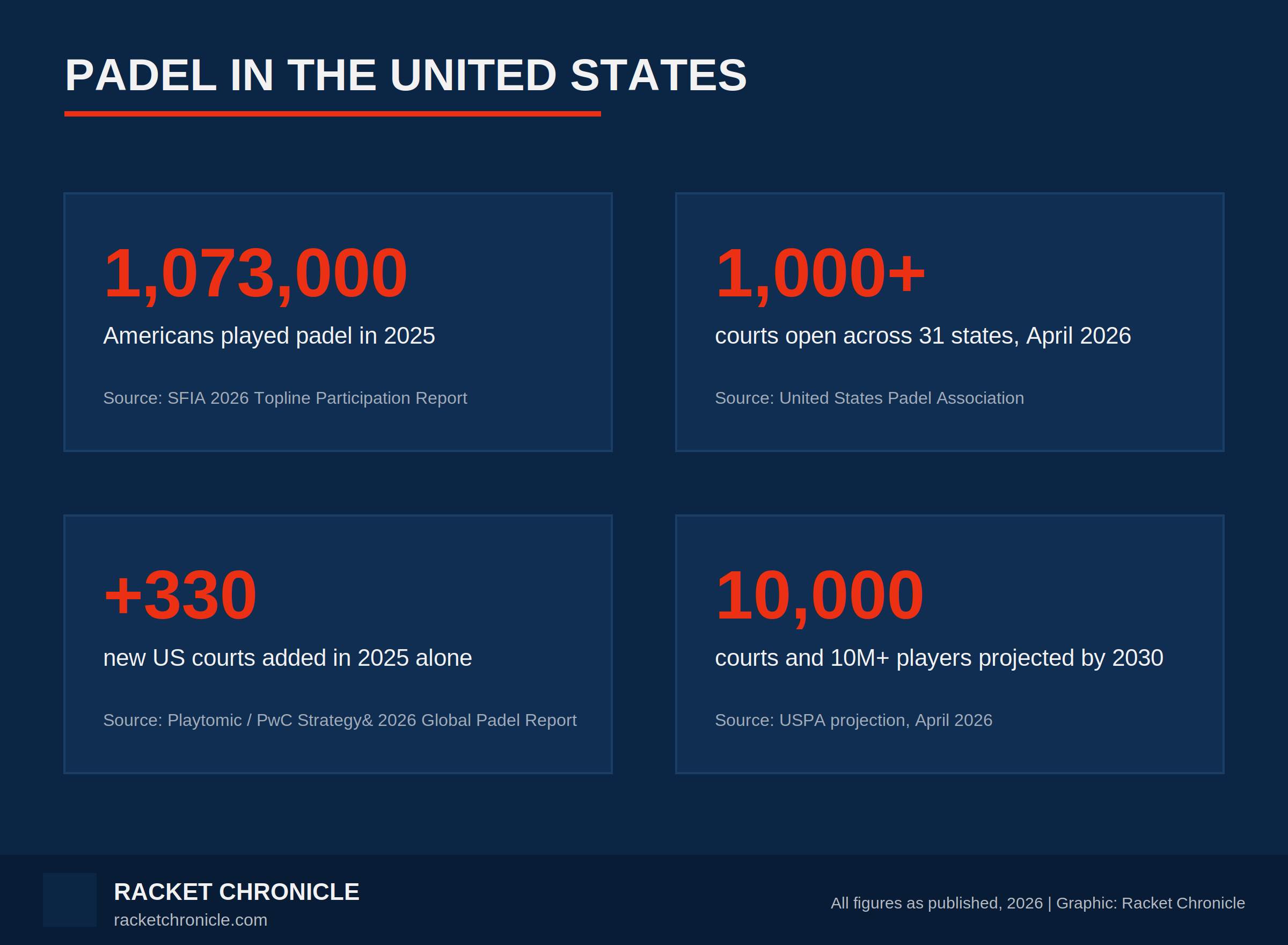
That US growth is measurable but still small relative to Europe. The United States Padel Association reported just over 1,000 courts open across roughly 31 to 37 states as of April 2026, based on the association's own figures from that month and a separate industry benchmark published the same month; the range reflects slightly different survey windows between September 2025 and April 2026 rather than a genuine disagreement about the underlying trend, which both sources describe as rapid. Florida accounts for about 41 percent of that court total, ahead of Texas, California, and New York. Padel participation in the US crossed one million players for the first time, according to the 2026 Topline Participation Report from the Sports & Fitness Industry Association, cited by the USPA in April 2026. That figure counts anyone who played padel at least once in the prior year, a much broader measure than the USPA's own formal membership, which stood at 2,915 individual members and 108 active clubs in the association's 2025 annual report, up 53.5 percent year over year. The USPA projects the country could reach 10,000 courts and more than 10 million players by 2030 if current growth holds.
Padel's infrastructure keeps expanding well ahead of any of these player counts settling into a single agreed figure. Playtomic's 2026 report recorded nearly 5,000 new clubs and almost 8,000 new courts added worldwide in 2025 alone, and the report projects the global total will reach about 91,000 courts by 2028.
What Is Padel Called in America?
Padel is called padel in the United States, the same as everywhere else; there is no separate American name for the sport itself. The confusion, when it happens, comes from two older and unrelated US racket sports with similar-sounding names. Paddle tennis is a smaller, unenclosed tennis variant that dates to the early 20th century in the US, played with a solid paddle and no walls. Platform tennis is a different sport again, invented in 1928 in Scarsdale, New York, played on a heated, elevated platform enclosed by wire screens rather than glass. Padel, paddle tennis, and platform tennis are three separate sports, with different courts, different equipment, and different governing bodies, despite the overlapping names.
How Is Padel Different From Tennis and Pickleball?
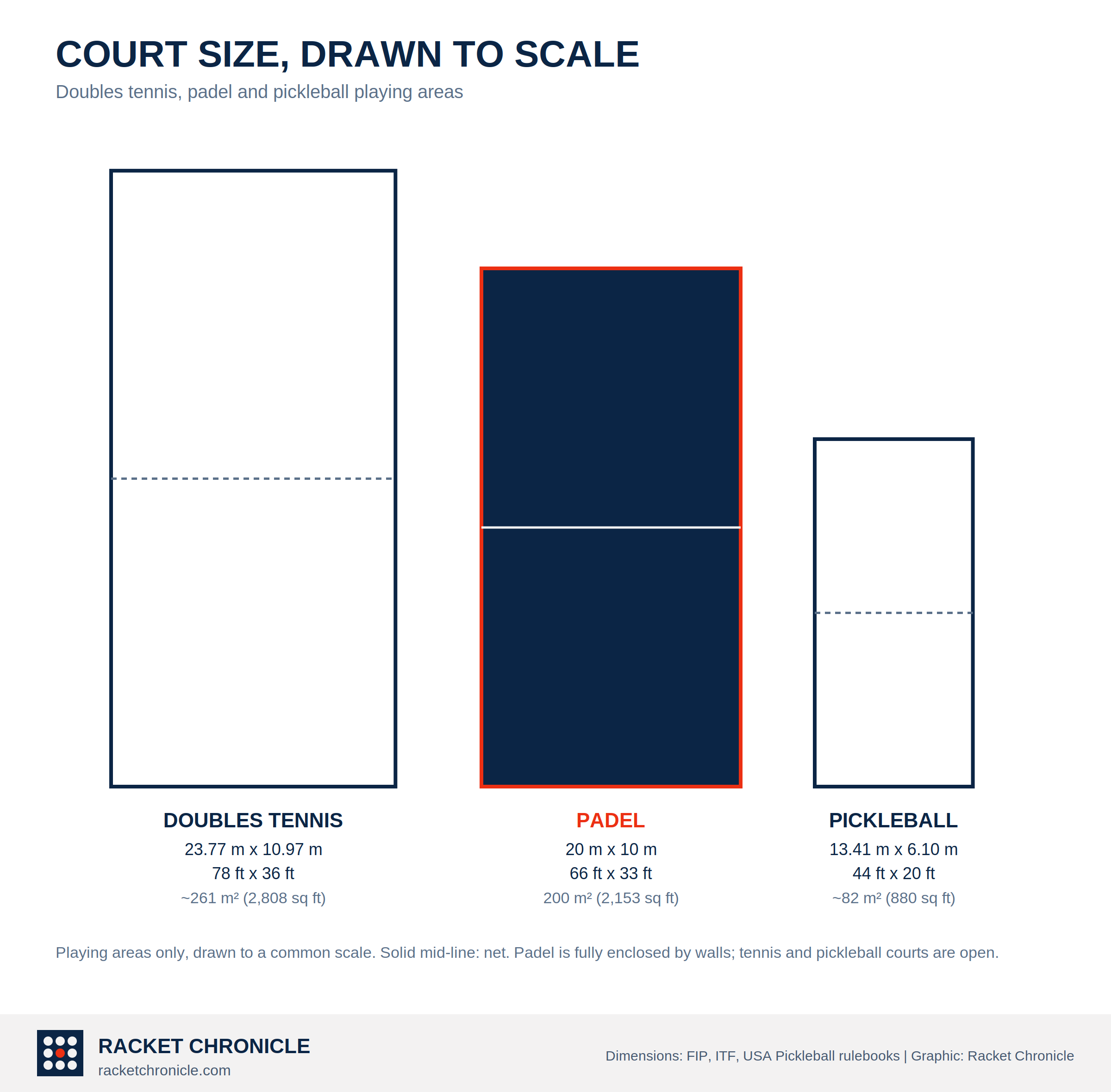
Padel and tennis share a scoring system but little else about how the games are played. A doubles tennis court measures about 23.8 by 11 meters (78 by 36 feet), well over padel's 20 by 10 meters, and shots landing outside a tennis court's lines are simply out. In padel, the enclosing glass and mesh walls keep the ball live after it bounces on the floor, turning wall rebounds into a core offensive and defensive tool with no equivalent in tennis. Equipment differs just as much: tennis rackets are strung and can run past 68 centimeters (27 inches) long, while padel rackets are solid, perforated, stringless, and capped at 45.5 centimeters (17.9 inches). Padel is also always doubles, where tennis offers both singles and doubles at every level.
Padel and pickleball get compared constantly because both have grown quickly in the US over the same few years, but the sports differ in court, equipment, and format. A pickleball court is about 13.4 by 6.1 meters (44 by 20 feet), smaller again than padel's, with no enclosing walls; the ball stays in play only within the painted lines, similar to tennis. Pickleball uses a hard plastic ball with holes and a solid paddle, while padel uses a lower-pressure rubber ball closer to a tennis ball and a larger, heavier composite racket. Pickleball can be played as singles or doubles and includes a no-volley zone near the net, known as the kitchen, that has no padel equivalent, and points can run considerably longer in padel once both pairs are set up at the net.
What Do You Need to Play Padel?
A padel racket, a padel ball, court shoes, and a partner cover the basics. The racket is solid rather than strung, built from a composite face over a foam or rubber core, and perforated with cylindrical holes across the hitting surface; FIP rules cap it at 45.5 centimeters (17.9 inches) long, 26 centimeters (10.2 inches) wide, and 38 millimeters (1.5 inches) thick, and require a non-elastic safety cord attached to the wrist. The ball looks like a tennis ball but carries less internal pressure and a slightly smaller diameter, which keeps its bounce lower and softer off both the racket and the walls.
Court shoes deserve more attention than racket choice for most beginners. Padel is played almost exclusively on artificial turf with sand infill, and the constant lateral movement and quick direction changes call for a shoe with a herringbone or multidirectional tread rather than the linear tread built for running shoes or the flat sole of a standard tennis shoe. Beyond that, normal athletic clothing is enough; padel carries no dress code requirement at club level the way some tennis clubs do.
What Is a Padel Club?
A padel club is a facility built around one or more padel courts, typically offering court bookings by the hour, group and private lessons, and organized social play alongside any competitive league or tournament activity it runs. Most clubs use a booking system similar to a tennis club: players reserve a court in blocks, usually 90 minutes, and pay per court rather than per player, which keeps the economics of a four-player game simple.
Open play formats are a bigger part of padel club culture than they are in tennis. Many clubs run rotating social sessions, sometimes called Americanos or Mexicanos, where players are paired with different partners across several short matches rather than committing to one fixed doubles pairing for the whole session. This format is a large part of why padel reads as a social sport as much as a competitive one: newer players can show up alone and be slotted into games without needing to arrange a group in advance.
Lessons at most clubs follow a similar path to tennis coaching: a beginner clinic covering grip, positioning, and the underarm serve, followed by group classes organized loosely by skill level, and private one-on-one sessions for players working on specific shots like the bandeja or the smash. Because a padel court holds four players comfortably, group lessons tend to run cheaper per person than equivalent tennis lessons on a full-size court, which is part of why clubs can offer coaching at a wider range of price points.
What Do Padel Terms Like Bandeja Mean?
Padel has its own vocabulary, borrowed mostly from Spanish, for shots and situations with no tennis equivalent. A bandeja, Spanish for tray, is a controlled overhead shot hit with backspin around shoulder height, used to hold a position at the net rather than to end the point outright. A vibora, Spanish for viper, is a more aggressive version of the same shot, hit with more pace and side-spin that makes the ball kick unpredictably off the back glass. A chiquita, Spanish for little one, is the opposite instinct: a soft, low shot aimed at the feet of players standing at the net, forcing an awkward defensive volley that can open up the point for the pair that hit it.
A golden point is what decides a game tied at 40-40 in club and recreational play: instead of playing advantage, the next point wins the game outright, regardless of which pair is serving. As of 1 January 2026, FIP's own rulebook lists a second scoring option called the Star Point, adopted for professional competition including Premier Padel, which allows up to two rounds of advantage before forcing a single decisive point. Club and social play mostly still use the traditional golden point or ordinary advantage scoring; the Star Point is, for now, a professional-level rule.
Padel FAQs
How long is a padel game?
How much do professional padel players make?
Who is the best padel player in the world?
What is the Pro Padel League?
Sources
International Padel Federation, "History," padelfip.com, updated February 2026. https://www.padelfip.com/history/
International Padel Federation, "Rules of Padel," Review of application 01.01.2026. https://www.padelfip.com/wp-content/uploads/2025/12/FIP_Rules-of-Padel.pdf
International Padel Federation, "FIP Rankings," accessed 10 August 2026. https://www.padelfip.com/fip-rankings/
Playtomic and Strategy& (PwC), "2026 Playtomic Global Padel Report" press release, 28 May 2026. https://padel-22.prowly.com/459723-2026-playtomic-global-padel-report-identifies-us-as-one-of-the-sports-biggest-long-term-growth-markets
United States Padel Association, "Padel Surpasses One Million Players in the United States," April 2026. https://padelusa.org/padel-surpasses-one-million-players-in-the-united-states/
Actu-Padel, "1,000 padel courts in the USA: the boom changes scale," 24 April 2026. https://actu-padel.com/en/1000-padel-courts-in-the-usa-the-boom-changes-scale/
Padel Earnings, "Premier Padel Prize Money 2026," accessed August 2026. https://padelearnings.com/premier-padel-prize-money
Padel Earnings, "Highest Paid Padel Players 2026," accessed August 2026. https://padelearnings.com/highest-paid-padel-players
Pro Padel League, "Pro Padel League Announces Broadcast Partnership With USA Sports for 2026 Season," 1 July 2026. https://propadelleague.com/news/pro-padel-league-announces-broadcast-partnership-with-usa-sports-for-2026-season/
Playtomic and Strategy& (PwC), "Global Padel Report 2026," report landing page, accessed August 2026. https://playtomic.com/global-padel-report
Playskan, "The Ultimate Padel Glossary," accessed August 2026. https://www.playskan.com/blog/padel-glossary
International Tennis Federation, "Rules of Tennis," Rule 1: The Court. https://www.itftennis.com/media/4421/2021-rules-of-tennis-english.pdf
Proud Padelista, "Padel vs Platform Tennis, Paddle Tennis, and Pickleball," accessed August 2026. https://proudpadelista.com/blogs/padel/padel-vs-platform-paddle-pickleball
USA Pickleball, "Official USA Pickleball Rulebook," accessed August 2026. https://usapickleball.org/rules/
PadelFans, "How long does a game of padel take?," accessed August 2026. https://padelfans.co.uk/learn/padel-match-length/