

Padel Racket Guide: How to Choose Your First Padel Racket
A padel racket is a solid, stringless paddle with a perforated hitting face, built for the enclosed, doubles-only sport of padel rather than adapted from tennis or squash equipment. For a first racket, the standard recommendation is a round-shaped, midweight frame with a soft or medium foam core, because that combination forgives off-center hits and asks the least of a swing that is still developing.
- The International Padel Federation caps a racket at 45.5 cm (17.9 in) long, 26 cm (10.2 in) wide, and 38 mm (1.5 in) thick, with a mandatory wrist cord.
- Choose in this order: weight, then balance, then shape, then core softness, then budget.
- Beginner rackets start around $80 to $100 at US retailers, with most players settling into the $120 to $250 range, according to current Racket Central and Tennis Warehouse listings.
What Is a Padel Racket?
A padel racket has no strings. The hitting face is a solid sheet of composite material, usually fiberglass or carbon fiber, bonded over a foam core, and drilled with dozens of small holes to cut air resistance through the swing. Padel is played in doubles on a fully enclosed court, and with no strings to generate spin or trampoline the ball the way a tennis racket’s stringbed does, the shape of the face, the density of the foam core, and the placement of the perforation pattern do most of that work instead.
The International Padel Federation sets hard limits on racket dimensions in the Rules of Padel, review of application 01.01.2026. The combined length of head and handle cannot exceed 45.5 centimeters (17.9 inches), the head cannot exceed 26 centimeters (10.2 inches) in width, and the racket cannot exceed 38 millimeters (1.5 inches) in thickness, with a 2.5 percent manufacturing tolerance allowed on thickness. The hitting surface must be perforated with cylindrical holes between 9 and 13 millimeters (0.35 to 0.51 in) across the center of the face, widening to as much as 20 millimeters (0.8 in) within 4 centimeters (1.6 in) of the edge. The USA Pickleball rulebook goes the opposite way: a pickleball paddle cannot have holes that break the paddle skin or hitting surface.
Every padel racket must also carry a non-elastic wrist cord, no longer than 35 centimeters (13.8 inches), fixed into the handle. FIP rules make its use compulsory during play, not optional safety gear, and Rule 13 of the Rules of Padel states that a player who breaks their safety cord during a point loses that point immediately. The cord exists for a practical reason: a rigid, unstrung racket that slips from a sweaty hand during a swing carries enough force to injure a partner, an opponent, or the court’s glass walls, all of which sit close enough on a padel court to be in range.
How Do You Choose Your First Padel Racket?
A round-shaped racket weighing 355 to 370 grams (12.5 to 13.1 oz), with a low or medium balance and a soft to medium EVA foam core, is the right starting point for almost every new padel player. That combination is the most forgiving across the four variables that actually change how a racket plays, and forgiveness counts for more than performance ceiling in the first several months of learning the sport.
Weight comes first because it’s the variable a new player feels most immediately. Adult padel rackets typically run 340 to 390 grams (12 to 13.8 oz), and manufacturer and retailer guidance consistently points beginners toward the lighter half of that range, under roughly 360 to 365 grams (12.7 to 12.9 oz), since a lighter frame is easier to control at the net and puts less strain on an arm still learning padel-specific motions like the underarm serve and the overhead bandeja.
Balance comes next. It’s measured as the distance from the base of the handle to the racket’s center of gravity, and while sources differ slightly on the exact cutoff, a racket balanced closer to the handle favors control and quick hands at net, while a racket balanced closer to the head favors power on smashes at the cost of maneuverability and comfort. A first racket should sit toward the handle-heavy end of that range.
Shape and core density both follow from the same logic and get their own sections below, because each has enough nuance to warrant it. Budget comes last on purpose: an inexpensive round, soft-core racket that matches a beginner’s level teaches better habits than an expensive diamond-shaped racket that punishes every mishit before a beginner’s technique can support it.
What Are the Three Padel Racket Shapes?
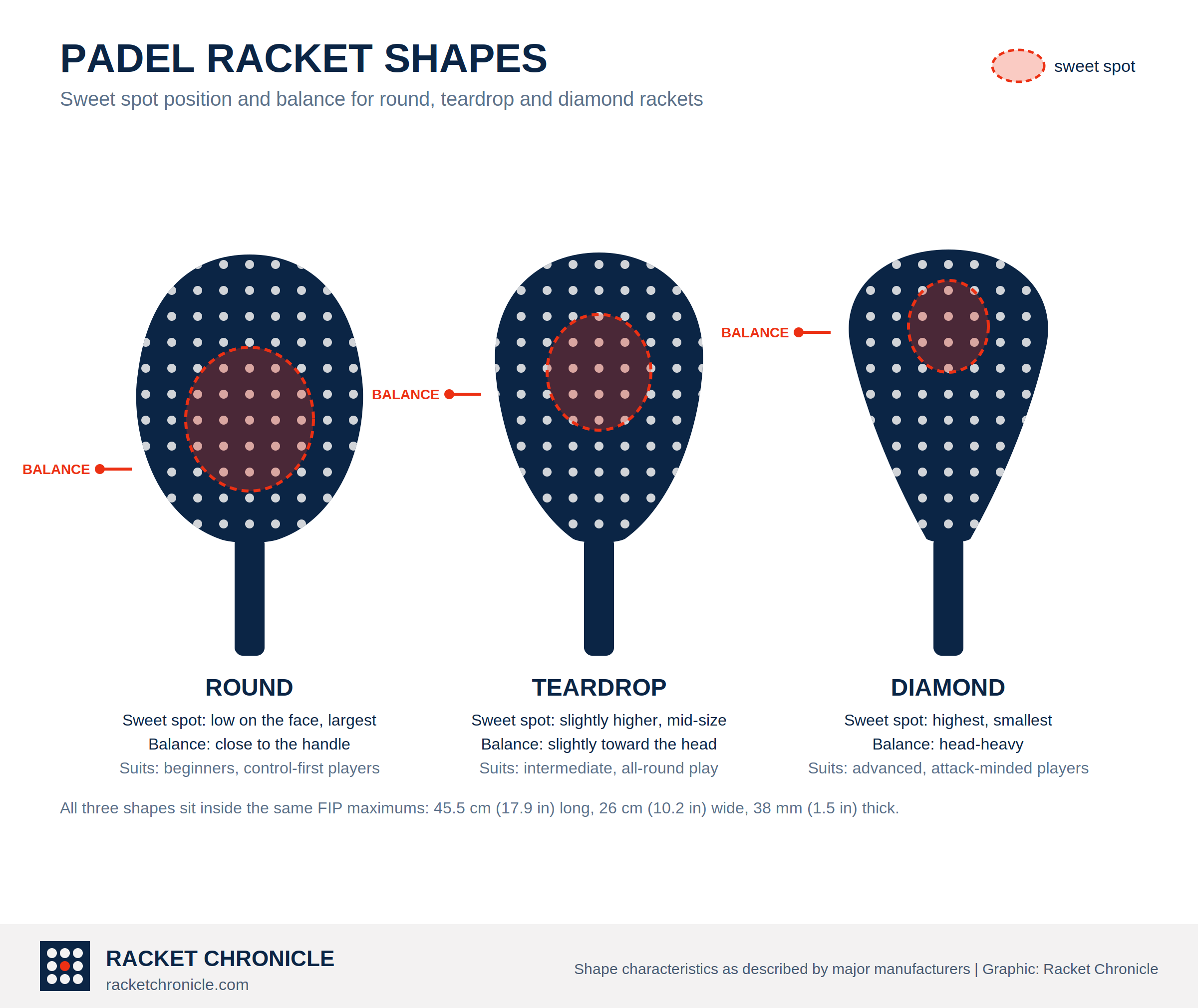
A round racket has its sweet spot centered low on the face, and it’s the largest sweet spot of the three shapes. Weight sits close to the handle, which keeps the racket light in the hand and forgiving on mishits, since even an off-center contact still returns the ball with reasonable control. This is the shape retailers and coaches consistently point beginners toward, and it stays a fine choice well past the beginner stage for players who prioritize control and defensive consistency over raw power.
A teardrop racket moves the sweet spot slightly higher on the face and shifts the balance a little toward the head, without going as far in either direction as a diamond. That middle position gives noticeably more pace on attacking shots than a round racket while staying reasonably forgiving on contact that isn’t perfectly centered, which is why it’s the shape many intermediate and club-level players settle into once they’ve outgrown a pure control racket.
A diamond racket puts the sweet spot at its highest point, closest to the tip of the head, and concentrates the most weight there too. That high, small sweet spot delivers the most power available from any shape, particularly on smashes and overheads, but it punishes off-center contact more than the other two shapes and demands the most from a player’s timing and technique. It’s the shape most associated with advanced, attack-minded players, and it’s the shape a beginner should avoid regardless of how appealing the power sounds on paper.
Should You Choose a Control or a Power Racket?
For a beginner, control is the correct answer, plainly. A control-oriented racket combines a round or teardrop shape, a handle-heavy balance, and a soft to medium foam core, usually paired with a fiberglass or hybrid fiberglass-carbon face. Every part of that combination trades outright power for forgiveness, a larger margin for error on contact, more comfortable vibration transfer to the arm, and an easier time keeping the ball in play during the long rallies padel’s enclosed walls tend to produce.
A power-oriented racket flips each of those choices: diamond shape, head-heavy balance, hard foam core, and a stiffer, often full-carbon face. That combination delivers more pace with less swing effort once a player can consistently strike the smaller sweet spot in the right place, but it does the opposite of forgive mistakes, and the added vibration transfer is a real factor for players prone to arm or elbow strain. A beginner reaching for a power racket is usually reaching for a problem before they’ve built the technique the racket assumes they already have.
Neither category is objectively better; the honest framing is that a control racket suits where a beginner’s game actually is, not where it might eventually be. Most players who stay in the sport gradually move their equipment toward power as their technique catches up, rather than starting there and fighting the racket for their first year.
What Are Padel Rackets Made Of?
The hitting face is almost always fiberglass, carbon fiber, or a mix of the two. Babolat describes its entry-level padel rackets as built with “soft fibers (carbonflex or fiberglass)” specifically for the elasticity and comfort that construction gives on impact. Fiberglass flexes more at contact, which softens the feel and helps generate power with less swing effort, and it shows up most often on beginner and comfort-focused rackets across brands. Carbon fiber is stiffer and transfers more of the player’s own swing speed directly into the shot, which rewards a consistent, well-timed swing with more control and pop but gives back less forgiveness on a mishit; it’s the standard face material on advanced and premium rackets from brands including Bullpadel and Head.
The core is almost always EVA foam today, ethylene-vinyl acetate, which largely replaced older polyethylene foam cores as manufacturing improved. EVA comes in soft, medium, and hard densities, and the density is the single biggest factor in how a racket feels on contact, independent of shape or balance. Soft EVA compresses more on impact, which softens the feel and adds comfort at the cost of some outright pace. Hard EVA compresses less, returning more of the player’s own swing energy directly into the ball for more speed and a crisper, more direct feel, but with less cushioning and more vibration reaching the arm.
None of this is a brand ranking, and it isn’t meant to be one. Two rackets with identical published specs, same shape, same weight, same core density, can still feel meaningfully different in hand, which is why hands-on comparison across price tiers is the most reliable way to separate a genuine performance difference from marketing language on a spec sheet.
How Much Does a Padel Racket Cost?
Entry-level rackets run from around $80 to $100 at both retailers checked. Racket Central lists beginner fiberglass frames starting near $80, and Tennis Warehouse’s full padel racket catalog, as of August 2026, includes several adult beginner models under $100, including the Tecnifibre Wall Master One at $89.00 and the Head Evo Extreme 2025 at $99.95, both listed at the beginner level.
The mid-range, where most club players end up buying, runs roughly $120 to $250 per Racket Central’s own stated range, with specific current examples bearing that out: the Head Radical Team 2026 lists at $209.95, the Wilson Endure LS v1 at $279.00, and the Babolat Veron Juan Lebron 3.0 at $270.00 at Tennis Warehouse, both retailers checked in August 2026.
Premium, full-carbon competition rackets run from around $280 up past $450. Tennis Warehouse currently lists the Head Radical Pro 2026 at $299.95, the Babolat Viper Juan Lebron 3.0 at $420.00, and several adidas Metalbone 2026 models between $375.00 and $455.00. At this tier, the price difference between models often comes down to marginal material upgrades and pro-tour association rather than a change any recreational player would necessarily feel.
How Long Does a Padel Racket Last?
No governing body or manufacturer publishes an official lifespan figure for a padel racket: playing frequency, swing style, storage habits, and racket quality all change the answer too much for one number to be useful. What manufacturers publish instead are warranty periods, and those cover manufacturing defects only, not normal wear from play.
Babolat’s own published terms state a one-year manufacturer’s defect warranty on its rackets from date of purchase. Other major brands commonly publish shorter terms, often around six months, covering manufacturing defects only, so a specific model’s terms are worth checking directly rather than assumed from a competitor’s policy.
Player-reported lifespan, which is commonly discussed across padel forums and retailer guides but isn’t an official figure from anyone, tends to fall somewhere between roughly six and eighteen months for players on court two to five times a week, shorter toward four to six months for daily or highly competitive play, and considerably longer, sometimes several years, for occasional or casual players. The signs that a racket needs replacing show up before most players expect them to: a “dead” feel on contact with noticeably less pop, increased vibration transferring to the arm, visible cracks anywhere in the frame or face, and a hollow or dull sound when the face is tapped with a knuckle, which usually signals the layers of the face have begun separating internally.
How Do You Grip a Padel Racket?
The continental grip is the standard grip for the large majority of padel shots, including the serve, volleys at net, and both the bandeja and the smash. To find it, hold the racket as if gripping a hammer, with the V formed by the thumb and index finger resting on the top bevel of the handle rather than rotated toward either face. Unlike tennis, which asks players to rotate between several grips through a single rally, padel’s shot variety is narrow enough that most players can stay in continental for nearly the entire match.
FIP rules require the wrist cord to be worn during play, and it should be tightened before every match or practice session rather than treated as an afterthought; it is the only thing preventing the racket from leaving a player’s hand at full swing speed.
Overgrips are a wear item and should be treated as one. Most players replace theirs every few sessions, more often in hot or humid conditions that increase sweat; the tell is a grip that feels slick or unresponsive rather than a fixed calendar interval. The base grip underneath sits on a much longer cycle, commonly every four to six months for a player on court several times a week, and should be replaced when the padding underneath feels compressed rather than cushioned.
Padel Racket FAQs
Where can you buy a padel racket?
Specialty padel and racket-sport retailers carry the widest current selection and are usually the fastest to stock new-season models. General sporting goods retailers, including national chains that have added dedicated padel sections as the sport has grown in the US, now carry padel rackets alongside tennis and pickleball gear. Buying directly from a manufacturer’s own site is also an option for most major brands and guarantees the warranty terms apply without a third-party reseller in the chain.
What is the difference between padel and paddle?
“Paddle” is the generic US word for the solid, stringless bat used in several racket sports, including pickleball and platform tennis, and it’s the source of most of the naming confusion around padel. “Padel,” the sport this racket is built for, is a distinct sport with its own governing body, its own enclosed-court format, and its own racket specification; “paddle tennis” is an older, separate US sport played on an open court with no enclosing walls. The two names sound alike and get used interchangeably online, but they describe different equipment for different games.
What is a padel racket used for?
A padel racket is used to strike the ball in padel, a doubles sport played on a small enclosed court where the ball stays live off the surrounding walls. It’s built to the FIP specifications covered above and is designed to work with padel’s specific pressurized ball rather than a tennis or pickleball ball. A racket alone doesn’t cover everything needed to play: the ball, court shoes with the right tread for artificial turf, and a grip setup all have their own padel equipment specifications.
Sources
International Padel Federation, “Rules of Padel,” Review of application 01.01.2026
Babolat, official US site, accessed August 2026
Racket Central, “Padel Rackets,” accessed August 2026
Tennis Warehouse, “Padel Warehouse,” accessed August 2026
Image: Depositphotos