

Pickleball Paddle Guide: Types, Shapes, Materials, and Rules
A pickleball paddle is a solid, rigid paddle built as a core between two face sheets, traditionally a polymer honeycomb core under a fiberglass, graphite or carbon-fiber face, with newer designs adding foam to the core. Paddles differ mainly in shape, thickness, weight and surface, and the 2026 USA Pickleball Official Rulebook limits size and surface while setting no limit on thickness or weight.
- A paddle is a core between two face sheets, with polymer honeycomb the traditional core and foam in newer designs.
- Shape and core thickness change the sweet spot and the feel, within a 43.18 cm (17 in) length limit and a 60.96 cm (24 in) combined length and width limit.
- The rulebook sets no weight or thickness limit, bans holes and added spin features on the hitting surface, and requires a paddle from the Approved Paddle List in tournaments.
What Is a Pickleball Paddle Made Of?
Pickleball is played with a solid paddle and a perforated ball, and a paddle is built in layers. The hitting surface is the face, and a core sits between two face sheets. An edge guard covers the rim, a grip covers the handle, and a butt cap closes the end of the handle; the rulebook counts the edge guard and butt cap in a paddle’s measured size. Onix Pickleball’s learning pages, as read October 20, 2026, describe the standard layout as a polymer honeycomb core between two face sheets of fiberglass, composite or carbon fiber, and they give core thickness in millimeters.
USA Pickleball’s account of paddle technology, “From Wood to Foam,” published June 10, 2026, divides the history into generations. First-generation composite paddles had a honeycomb core between two face layers; early cores were polypropylene, aluminum or Nomex, and the faces were commonly fiberglass and later graphite. Second-generation paddles introduced thermoforming, a process that uses heat and pressure to form a more unified paddle structure. Third-generation paddles typically pair a polypropylene honeycomb core with an EVA foam perimeter, and fourth-generation designs generally use full foam cores, often with several foam densities and internal layups.
Thermoformed describes how a paddle is made, and USA Pickleball ties it to the second generation and notes that the process had already been used for years in tennis, golf and baseball. Graphite, fiberglass and carbon fiber describe the face sheets: the USA Pickleball page names fiberglass and later graphite, and Onix adds composite and carbon fiber. The rulebook names none of these core or face materials. It sets a performance rule instead: a paddle must be made of rigid, non-compressible material that meets the criteria in the USA Pickleball Equipment Standards Manual.
That manual allows any material deemed safe and not prohibited, and it prohibits springs or spring-like material, flexible membranes and any compressible material that creates a trampoline effect. This article reads Revision 3.0 of the manual, dated January 2025. Face and core materials can differ widely, and the limits come from test results and surface features, not from a list of permitted materials.
What Are the Pickleball Paddle Shapes and Sizes?
The rulebook limits a paddle’s combined length and width, including any edge guard and butt cap, to 60.96 cm (24 in), and its length to 43.18 cm (17 in). Shape is not defined in the rules. Subtracting the two limits is Racket Chronicle’s arithmetic: a paddle at the 43.18 cm (17 in) length limit can be at most 17.78 cm (7 in) wide, and a paddle that is 20.32 cm (8 in) wide can be at most 40.64 cm (16 in) long.
Manufacturers sort paddles into shapes that fit inside those limits. Onix Pickleball, as read October 20, 2026, describes a standard shape as typically 40.64 cm by 20.32 cm (16 in by 8 in), a widebody as shorter than 40.64 cm (16 in) and wider than 20.32 cm (8 in), and an elongated paddle as longer than 40.64 cm (16 in) and narrower than 20.32 cm (8 in). Pickleball Central’s paddle guide, read the same day, uses different words: it describes standard shapes as modeled on the original paddles with the widest sweet spot, a hybrid shape between standard and elongated, and elongated paddles as maximizing reach with the most power potential. Vocabulary differs between sellers, so the dimensions say more than the label.
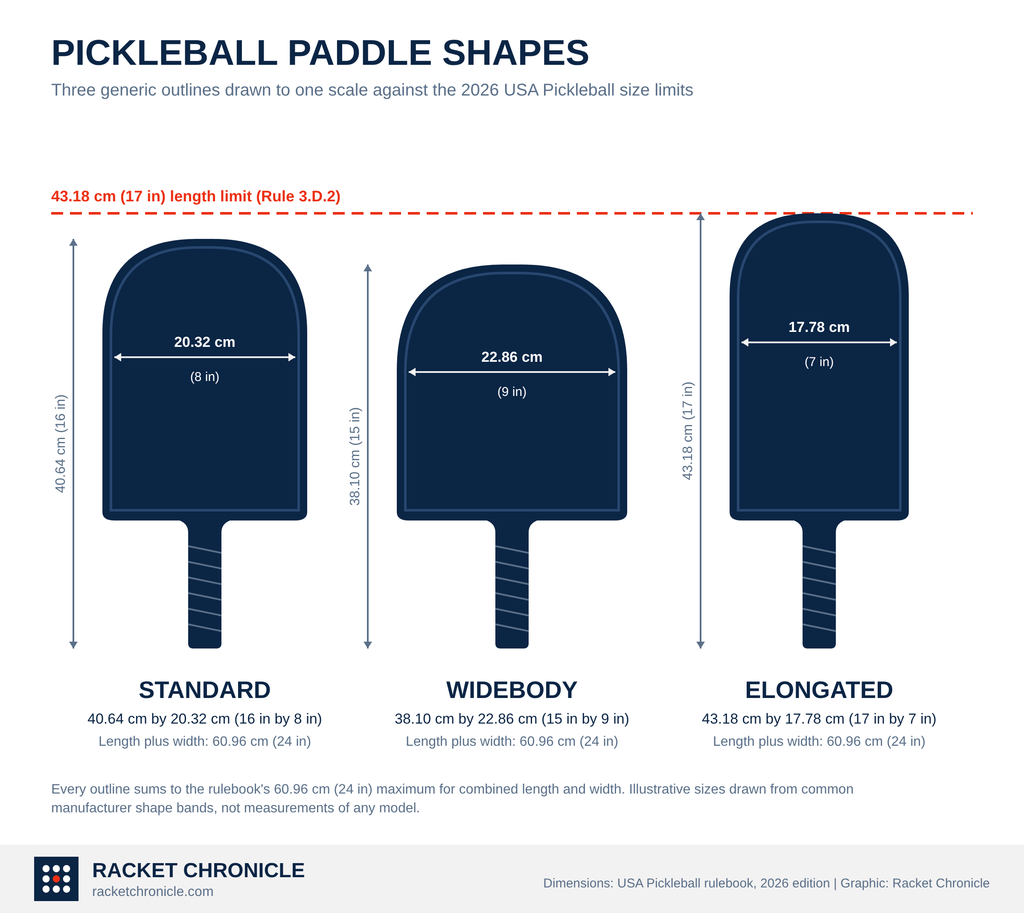
Sweet-spot behavior follows the same split. Onix describes wider paddles as offering a bigger sweet spot and elongated paddles as giving better reach, and says a handle shorter than 13.97 cm (5.5 in) allows a bigger sweet spot on the face. Pickleball Central’s guide groups handles as short (12.7 cm (5 in) or less), standard (12.95 to 13.72 cm (5.1 to 5.4 in)) and extended (13.97 cm (5.5 in) or more), and says extended handles push the balance higher for more power on full swings. Those are manufacturer and retailer descriptions of tendencies, not measured rules, and a given paddle can differ from its shape’s tendency.
How Does Paddle Thickness Change the Way a Paddle Plays?
Thickness is the depth of the core, measured in millimeters, and the rulebook places no restriction on it. Pickleball Central’s paddle guide, read October 20, 2026, says paddles come in thicknesses from 8 to 20 mm, and its shop filters group them as thin (12 mm or less), standard (12.1 to 14 mm), thick (14.1 to 16 mm) and over 16 mm.
The long-standing summary comes from manufacturers. Onix, as read October 20, 2026, says a thinner core compresses the ball and releases it faster, which accounts for the pop players notice and makes mishits felt more, while a thicker core absorbs more of the ball’s energy, which gives more time and touch for dinks and resets and tends to enlarge the sweet spot. The same page says thicker does not automatically mean heavier, as overall weight depends on the combination of core and face material.
A testing site complicates the 14 mm versus 16 mm comparison. Pickleball Effect’s article by Matt Reny, published July 24, 2026, reports that in its database older 14 mm paddles from the first and second generations average the 33rd percentile for firepower and modern 16 mm paddles the 73rd, with near-identical average swing weight (113.0 versus 113.1), and that firepower rose at 16 mm in three of four matched pairs. In the fourth pair it fell. The article adds that the 16 mm version held more stability on off-center hits in nearly every matched pair, though it calls that not an absolute guarantee. The page does not describe its test method or sample size, and the site carries an affiliate disclosure, so the findings are one commercial tester’s view, not a measured standard.
What Do the Rules Say About Pickleball Paddles?
The rulebook’s paddle section requires a clearly marked brand and model name or number and the “USA Pickleball Approved” seal or text treatment. Paddles made before the seal requirement must still appear on the Approved Paddle List for sanctioned play. Beyond the length and combined size limits, the rulebook sets no restriction on weight or thickness. The hitting surface cannot contain holes, cracks, delamination or indentations that break the paddle skin or surface, rough texturing, sandpaper characteristics, natural or synthetic rubber, moving parts that can increase head momentum, anti-skid paint or any material that adds spin, other features that allow excessive spin, or a reflective finish that could affect opponents’ vision. A padel racket differs on the first of those: the International Padel Federation’s Rules of Padel, review of application 01.01.2026, require the hitting surface to be perforated with cylindrical holes of 9 to 13 mm (0.35 to 0.51 in) in the center area, while a pickleball paddle’s hitting surface cannot have holes that break the surface.
The Equipment Standards Manual, Revision 3.0 (January 2025), tests surface roughness in six directions with an average no greater than 30 micrometers on Rz and 40 micrometers on Rt, and a kinetic coefficient of friction of 0.1875 or lower. USA Pickleball’s page “USA Pickleball Spin Rate Test Update and Timeline,” published July 8, 2026 and modified September 16, 2026, states that from October 1, 2026 every paddle submitted for certification must measure a spin rate of 2,100 RPM or less, and that the upper thresholds for roughness and friction are replaced by a measurement of record. Until that date, the page says, paddles meeting the roughness and friction requirements could still be certified under the existing standards, and certified paddles must comply with the standards in effect at the time of certification.
Players can alter a certified paddle only in listed ways: adding or replacing edge guard tape, adding weighted tape, adding or removing weights on a weight system built into the paddle by its original manufacturer, replacing interchangeable grips or faces from that manufacturer, adding name decals or identification marks, changing grip size with inserts, adding or replacing grip wrap, and handwritten identification marks. Decals and tape cannot extend more than 2.54 cm (1.0 in) above the top of the grip or more than 1.27 cm (0.5 in) inside the outer edge of the paddle or its edge guard. In tournament play, the rulebook requires players to use an approved paddle that meets the specifications. A non-listed or non-compliant paddle found before a match means a switch with no penalty, found while a match is being played means a match forfeit, and found after a match ends leaves the results standing.
A paddle reaches the Approved Paddle List through certification testing, and Section 2.F.2 of the Equipment Standards Manual subjects manufacturers to ongoing compliance testing so that paddles as produced and sold match the paddle that was certified. USA Pickleball’s statement of May 16, 2024, updated June 4, 2024, removed 17 JOOLA models after JOOLA told it that it had submitted the wrong paddles for certification in November 2023; the update says newly submitted paddles were tested at a third-party facility and did not meet its equipment standards, and its FAQ says compliance samples are discreetly acquired, screened and, if necessary, tested at an independent lab. A USA Pickleball statement published in February 2025 gives February 13 as the date it removed the Chorus Fire EX and SX paddles, which were submitted in November 2024 and listed as approved on November 22. The statement says its testing facility had not fully tested them against the paddle-ball coefficient of restitution (PBCoR) standard when they were listed, and that both paddles failed the full test.
How Long Do Pickleball Paddles Last, and How Do You Care for Them?
Pickleball Central’s guide “How Long do Pickleball Paddles Last? A Guide to Paddle Care,” dated February 15, 2022, says the average lifespan of a well-made paddle ranges from 1 to 5 years, depending on material, play intensity, environmental exposure and manufacturing quality, and says competitive players wear paddles out faster than recreational players. That is one retailer’s estimate and not a measured result, and it gives no play-hour figure.
The same guide lists signs of wear: reduced ball control and less grip or spin, a change in sound that can point to internal damage, deep scratches, edge chips or a loosening grip, and flaking, cracking or warping of the surface. It describes delamination as surface bubbling, a hollow or unusual sound and reduced power. A face that has delaminated enough to break the surface also runs into the rulebook’s ban on delamination that breaks the paddle skin, and the Equipment Standards Manual requires a certified paddle to stay compliant over the entire useful life of the paddle, including any gradual change in performance.
For care, the guide advises wiping a paddle with a damp, clean cloth after play, taking care not to drench it, a gentle monthly wash with mild soap and water followed by thorough drying, annual grip replacement or sooner if it turns slippery, and cool, dry storage with a cover for outdoor play. It does not address rain or soaking directly, and says paddles stored in humid conditions or left in the sun might deteriorate faster.
Which Paddle Suits a Beginner or a Junior Player?
Guides for newer players from manufacturers and retailers center on weight, grip size and shape, and the surface is set by the rules described above. Weight classes differ between sellers. Onix, as read October 20, 2026, calls paddles of 207 g (7.3 oz) or less light, 210 to 238 g (7.4 to 8.4 oz) mid weight and 241 g (8.5 oz) and up heavy, with light paddles offering more control and maneuverability and heavy paddles more power. Pickleball Central’s paddle guide, read the same day, uses different bands: 213 g (7.5 oz) and under featherweight, 215 to 221 g (7.6 to 7.8 oz) lightweight, 224 to 232 g (7.9 to 8.2 oz) mid weight and 235 g (8.3 oz) and over heavyweight. The rulebook sets no weight limit, so the class names are marketing conventions and the bands overlap only in part.
Grip size is circumference. Pickleball Central’s guide gives small as 9.53 to 10.48 cm (3.75 to 4.125 in), medium as 10.80 to 11.43 cm (4.25 to 4.5 in) and large as 11.43 to 12.07 cm (4.5 to 4.75 in). It says to measure from the middle crease of the dominant palm to the tip of the ring finger, to choose the smaller size when unsure between two, and that most players are fine with small or medium. Overgrips can add size, and little can be done to reduce it.
Junior paddles are sold as their own category. Pickleball Central’s Kids and Junior Paddles page, read October 20, 2026, listed six products, among them lightweight composite paddles labeled with a small grip and wood paddles. Rule 3.D contains no separate junior specification, so the 43.18 cm (17 in) length limit and 60.96 cm (24 in) combined limit apply to a junior paddle as to any other.
How Much Does a Pickleball Paddle Cost?
No official price exists. USA Pickleball sets equipment standards and keeps the approved list, and manufacturers and retailers set prices. Pages read on October 20, 2026 show the spread. Onix Pickleball’s recreational paddle collection listed single paddles from $39.99, and its tournament paddle collection of 12 listed prices from $99.98 to $269.99. Pickleball Central’s Kids and Junior Paddles page listed a poly-core composite starter paddle at $34.99, and the first page of its thick-core paddle category, 191 products in all, showed prices from $129 to $299.95.
Those listings are examples and not an average or a market survey, and a retailer’s sale price can change. Together they span $34.99 to $299.95, so a figure from one store does not describe another. None of the pages read gave a current average price.
Pickleball Paddle FAQs
What is the best type of paddle for pickleball?
No single type is best; the choice depends on the player and on the rule limits. A paddle for tournament play must be on the USA Pickleball Approved Paddle List and stay within 43.18 cm (17 in) in length and 60.96 cm (24 in) in combined length and width. Within those limits, manufacturers describe widebody shapes as offering a bigger sweet spot, elongated shapes as offering more reach and thicker cores as offering more control, and one testing site’s 2026 data found modern 16 mm paddles averaging higher firepower than older 14 mm paddles.
Is there a difference between pickleball paddles?
Yes. Paddles differ in shape (standard, widebody or elongated), core thickness (commonly 14 mm or 16 mm), weight, face material and surface texture, and in the core, which is traditionally polymer honeycomb and increasingly foam. The rulebook limits length, combined size and surface features but sets no weight or thickness limit, so legal paddles can differ widely.
How do I choose a pickleball paddle for beginners?
Start with the size limits and, for any tournament play, the Approved Paddle List with a clearly marked brand and model. Then look at weight, grip size and shape. Seller weight bands differ, with Onix calling 207 g (7.3 oz) or less light and Pickleball Central calling 213 g (7.5 oz) or less featherweight, and Pickleball Central advises choosing the smaller grip when a player is unsure between two sizes.
Can you use a tennis racket or a padel racket to play pickleball?
The rulebook never uses the word racket; it calls the implement a paddle and requires rigid, non-compressible material with no holes that break the hitting surface (Rules 3.D.4 and 3.D.5.a). A tennis racket is strung, and a padel racket’s face is perforated with holes of 9 to 13 mm (0.35 to 0.51 in) in the center under the International Padel Federation’s rules, so a padel racket conflicts with the hole ban. In tournaments the rulebook requires a paddle on the Approved Paddle List, so a racket from another sport cannot be used there.
How heavy is a pickleball paddle?
The rulebook sets no weight limit, so weights vary by model. Seller bands read October 20, 2026 run from 207 g (7.3 oz) or less for light paddles to 241 g (8.5 oz) and up for heavy ones at Onix, and Pickleball Central’s heavyweight band starts at 235 g (8.3 oz). Onix lists one recreational composite paddle at 191 to 206 g (6.75 to 7.25 oz).
Sources
USA Pickleball, “2026 Official Rulebook”
USA Pickleball, “Equipment Standards Manual,” Revision 3.0, January 2025
USA Pickleball, “USA Pickleball Spin Rate Test Update and Timeline,” modified September 16, 2026
Image: Depositphotos
