

14mm vs 16mm Pickleball Paddle Differences
The difference between the two is 2 mm of core depth, 14 mm (0.55 in) against 16 mm (0.63 in), and manufacturers say the thinner core gives more pop while the thicker core gives more control and a larger sweet spot. One testing site’s 2026 data points the other way on power, so no single answer holds for every paddle.
- Core thickness is the depth of the core between the two faces, measured in millimeters; it is not length, width or weight class.
- Manufacturers say 14 mm pops and 16 mm controls, while Pickleball Effect’s 2026 data has current 16 mm paddles averaging higher firepower than older 14 mm paddles.
- The USA Pickleball rulebook sets no limit on paddle thickness; length, combined size and approval rules still apply.
What Does Core Thickness Measure in a Pickleball Paddle?
Pickleball is played with a rigid paddle and a perforated ball, and the core is the layer between the paddle’s two face sheets. Onix describes a polymer honeycomb core under faces of fiberglass, composite or carbon fiber. Core thickness is that layer’s depth in millimeters, and Onix says it has nothing to do with the paddle’s length, width or weight class.
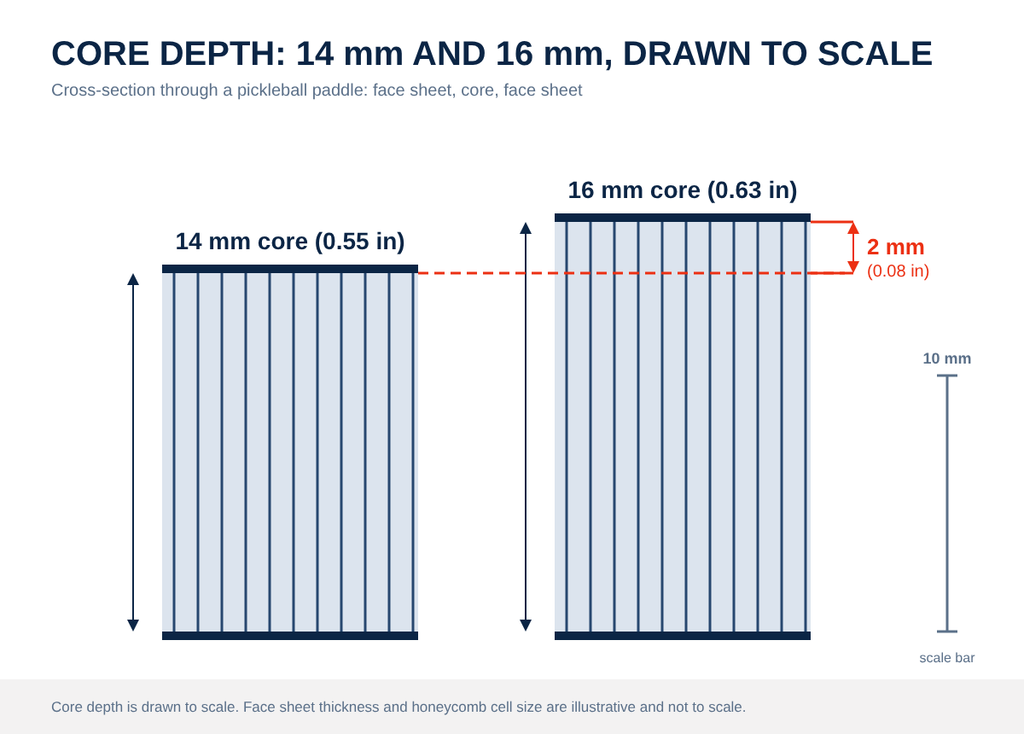
Most paddles cluster in a narrow band. Pickleball Central’s 2023 explainer says cores are mostly 14 to 16 mm today, with examples as thin as 11 mm and as thick as 19 mm. The rulebook places no limit on paddle thickness, so makers can build anywhere in that range and beyond.
Labels for the groups shift between retailers. Scheels calls 12 mm thin, 14 mm standard and 16 mm thick, while Pickleball Central notes that 13 mm was once the midpoint and that newer materials have made thicker cores common. A paddle sold as thick today could have been standard a few years ago, so the millimeter figure is more reliable than the label.
How Does a 14mm Paddle Play Compared With a 16mm Paddle?
The manufacturer and guide claims point the same way. Onix says a 14 mm core compresses and releases the ball faster, which gives pop and makes mishits easier to feel. It says a 16 mm core absorbs more energy, slows the ball and gives more time for dinks, drops and resets, with a larger sweet spot. Bounce says the same about dwell time, feel and sweet spot, and Pickleball Union lists more power and a smaller sweet spot for 14 mm, and more control for 16 mm.
The sources split on weight. Onix says a 14 mm paddle usually has less swing weight, yet also says thicker does not automatically mean heavier, as total weight depends on both core and face material. Pickleball Union lists heavier as a 16 mm drawback. Bounce says a 14 mm core mainly adds pop on short swings and that drive power depends more on swing mechanics and paddle construction.
On who each suits, Onix points aggressive, offense-first players to 14 mm and newer, patient and doubles players to 16 mm. Bounce points singles players who rely on power to 14 mm and doubles players who work the kitchen to 16 mm. Both point newer players to 16 mm. Onix says personal feel decides when those pointers conflict, and suggests testing both thicknesses of the same paddle so thickness is the only variable.
None of the three publishes test data for these claims. Onix sells paddles in both thicknesses and Bounce promotes its own coaching, leagues and courts, so the descriptions are qualitative, and two of the three come from businesses with something to sell.
What Does the Testing Data Say About 14mm and 16mm Paddles?
Pickleball Effect has two relevant articles. The earlier one, by founder Braydon Unsicker, was published in October 2024 and updated in January 2026. It reports averages from a database of more than 200 paddles: twist weight, a stability measure, averages 6.5 for 16 mm paddles and 6.1 for 14 mm paddles, and swing weight averages 117 against 113. It says 14 mm paddles have lower power on full swings but more pop on short swings. A spin test of over 100 paddles, 10 serves each, found no thickness advantage on serves. The article does not say how many paddles sit in each thickness group.
The July 24, 2026 article by Matt Reny argues that foam construction has changed the trade. In the site’s database, older 14 mm paddles from the first two generations average a swing weight of 113.0 and a firepower percentile of 33, while current 16 mm paddles average 113.1 and a firepower percentile of 73. In four matched pairs of current paddles, firepower rose at 16 mm in three and fell in one, a hybrid-shape paddle that went from the 57th to the 51st percentile. A two-shape line from the previous generation rose in both shapes.
That data has limits the article does not close. It states no test method, no database size and no percentile formula, and the site carries an affiliate disclosure. The database comparison sets older 14 mm paddles against newer 16 mm paddles, so it mixes thickness with construction, which the article itself describes as generational change. No independent measurement of the same question turned up, so the testing evidence on 14 mm against 16 mm is one commercial tester’s view, not a measured standard.
Which Thickness Suits Which Player?
The guides tie thickness to play style. Onix and Bounce match 14 mm to aggressive and singles play and 16 mm to control and doubles, and the earlier Pickleball Effect article suggests players rated 4.25 and above try 14 mm while recommending 16 mm for most others. All of that is advice, and none of it comes with a measurement of players or outcomes.
Reny reads the paddle as having changed more than the rule of thumb. He describes the first two generations as a trade, 14 mm for speed, quick hands and pop, and 16 mm for weight and stability. By the third generation the cost of choosing 16 mm had started to shrink, which he credits to whole-paddle construction rather than thickness alone, and he says foam construction in the newest generation made that the rule. Within the current 16 mm group, his database shows swing weight percentiles from the 2nd to the 95th and a wide firepower range too, so a 16 mm paddle can be light and lively or heavy and stable. On that evidence thickness alone predicts little. He says there is very little reason left for most players to choose 14 mm, a view that sits against Onix’s case for 14 mm, and he tells anyone whose 16 mm paddle does not feel right to trust their hands over the numbers.
The practical reading is narrow: thickness is one input beside swing weight, twist weight, face material, shape and grip size, and the same millimeter figure can describe quite different paddles. Elongated versus widebody shape and grip size are separate specifications that core thickness does not settle.
Do the Rules Limit Paddle Thickness?
No. The 2026 USA Pickleball Official Rulebook says there is no restriction on paddle thickness, and none on weight. The limits that apply are a length of 43.18 cm (17 in) and a combined length and width of 60.96 cm (24 in), including edge guard and butt cap. The padel rulebook goes the other way: the International Padel Federation’s Rules of Padel cap the head of a padel racket at 38 mm (1.5 in) thick.
Approval is separate. The rulebook requires a clearly marked brand and model and the USA Pickleball Approved seal or text treatment, and paddles made before that requirement must still appear on the Approved Paddle List for sanctioned play. A 14 mm and a 16 mm paddle are both legal on thickness, and the list decides whether either is usable in tournaments.
14mm vs 16mm Pickleball Paddle FAQs
Is a 14mm or 16mm pickleball paddle better for beginners?
Onix calls 16 mm often the safer recommendation for new and intermediate players, and Bounce also recommends 16 mm for beginners. Their reasons are a larger sweet spot and a softer feel, and neither backs the claim with test data. The earlier Pickleball Effect article suggests 16 mm for most players below a 4.25 rating.
Do thicker pickleball paddles have more power?
Not reliably. Onix, Bounce and Pickleball Union say thinner cores give more pop, and the earlier Pickleball Effect article says 14 mm paddles have lower power on full swings and more pop on short ones. Its July 2026 data shows current 16 mm paddles averaging a higher firepower percentile than older 14 mm paddles, though one matched pair fell at 16 mm, so thickness alone does not settle it.
Is a 16mm pickleball paddle heavier than a 14mm paddle?
Not necessarily. Onix says thicker does not automatically mean heavier, as total weight depends on both core and face material. Pickleball Effect’s earlier database has 16 mm paddles averaging a swing weight of 117 against 113 for 14 mm, while its 2026 data has current 16 mm paddles at 113.1 against 113.0 for older 14 mm paddles. Onix advises checking the listed weight alongside core thickness.
Is there a limit on pickleball paddle thickness?
No. The 2026 USA Pickleball Official Rulebook says there is no restriction on paddle thickness or weight. Length is capped at 43.18 cm (17 in) and combined length and width at 60.96 cm (24 in). A paddle used in sanctioned play must also be on the Approved Paddle List.
What does pickleball paddle thickness mean?
It is the depth of the paddle’s core, measured from face to face in millimeters. Most paddles sit between 14 and 16 mm, with a 2 mm gap between the two common sizes. Onix says the figure has nothing to do with a paddle’s length, width or weight class.
Sources
USA Pickleball, “2026 Official Rulebook”
Onix Pickleball, “14mm vs. 16mm Pickleball Paddles”
Pickleball Effect, Matt Reny, “14mm vs 16mm Pickleball Paddles in 2026,” July 24, 2026
