

Padel shoes are court shoes built for the sand-dressed artificial turf padel is played on, with a tread pattern and lateral reinforcement engineered for that specific surface. Standard hard-court tennis shoes fall short on a padel court because their outsoles are built to grip abrasive acrylic, not loose sand sitting on top of turf fibers.
- A padel shoe pairs a turf-specific outsole, herringbone, omni, or hybrid, with reinforced lateral support and a reinforced toe for wall play; it is not a relabeled running or basketball shoe.
- Hard-court tennis shoes fall short on padel turf, but a clay-court tennis shoe with a full herringbone outsole is a genuine, workable substitute.
- Padel shoes run roughly $90 to $180 at current US retailers, according to Tennis Warehouse and Racket Central listings checked in August 2026.
What Are Padel Shoes?
A padel shoe is a court shoe built around one surface: sand-dressed artificial turf, the material padel is overwhelmingly played on in practice. The International Padel Federation's Rules of Padel technically permit a court floor of cement, synthetic material, or artificial grass, provided it gives a regular ball bounce, and the rulebook's attire section asks only for suitable sports footwear rather than naming a specific shoe type. In practice, though, artificial turf dressed with silica sand has become close to the standard surface, and shoe construction has followed that surface rather than the letter of the rule.
Padel is played in doubles on a fully enclosed court, and the combination of that turf-and-sand floor with constant lateral movement is what a padel shoe is actually solving for. Padel rackets are solid and stringless, an equipment choice that's effectively fixed once bought; a shoe's outsole and fit are the piece of kit a player adjusts most often as their surface or level changes. The outsole pattern, the density of the rubber compound, and the amount of lateral reinforcement built into the upper are what separate a padel shoe from a generic trainer that happens to be the right size.
Toe and medial reinforcement is the other structural giveaway. Padel's wall play means a foot drags across the turf on serves, defensive gets, and shots played off the back glass far more than it does in most racket sports, and a padel shoe's toe cap and medial wall are built to absorb that repeated abrasion in a way a running or basketball shoe's upper is not.
FIP's own attire rule is deliberately loose on this point: it requires suitable sports footwear and threatens a fault, then disqualification, for noncompliance, without specifying an outsole type or brand. That looseness is why the shoe market split the way it did. Nothing in the rulebook forces a manufacturer to build turf-specific tread, so the current range of padel-specific outsoles exists in response to what the surface actually demands in practice, not because a governing body wrote a spec sheet for it the way FIP did for the racket and ball.
Why Do Tennis Shoes Fall Short on a Padel Court?
Hard-court tennis shoes fall short on a padel court because their outsoles are built for an entirely different job. A hard-court tennis outsole uses a modified herringbone or all-court pattern in a dense, abrasion-resistant rubber compound designed to grip and release on rigid acrylic, and that compound and pattern do not interact well with loose sand sitting on top of turf fibers. The grip is inconsistent, the tread clogs with sand faster than it sheds it, and the flex pattern built for a hard, flat surface doesn't match the slight give of turf.
The wear pattern gives this away quickly. A hard-court tennis shoe worn regularly on padel turf tends to smooth out across the forefoot faster than it would on the surface it's built for, since the sand acts as an abrasive the outsole rubber wasn't formulated to resist, and the lateral support built into a tennis shoe's upper is tuned for a tennis player's stride and stopping pattern rather than padel's tighter, more constant side-to-side movement on a much smaller court.
The honest exception is clay. A clay-court tennis shoe, built around a full herringbone outsole rather than a hard-court's all-court pattern, is a genuinely workable padel substitute, and it isn't just a coincidence: several brands sell close to the same sole under both a clay-court tennis shoe and a padel shoe. Tennis Warehouse's own padel shoe catalog lists clay-court tennis models from K-Swiss, adidas, Wilson, Head, and Lacoste within its padel shoe catalog, and Asics sells its Gel Resolution X, a long-running clay and hard-court tennis shoe, in a dedicated Padel version built on close to the same platform. A player who already owns a full-herringbone clay shoe does not need to replace it to try padel.
A dedicated padel shoe adds toe and medial reinforcement a repurposed clay shoe won't have, which counts for more once wall play and toe-drag become a regular part of a player's game, but the clay crossover is real and worth knowing before spending on a padel-specific pair.
What Sole Pattern Do You Need for Padel?
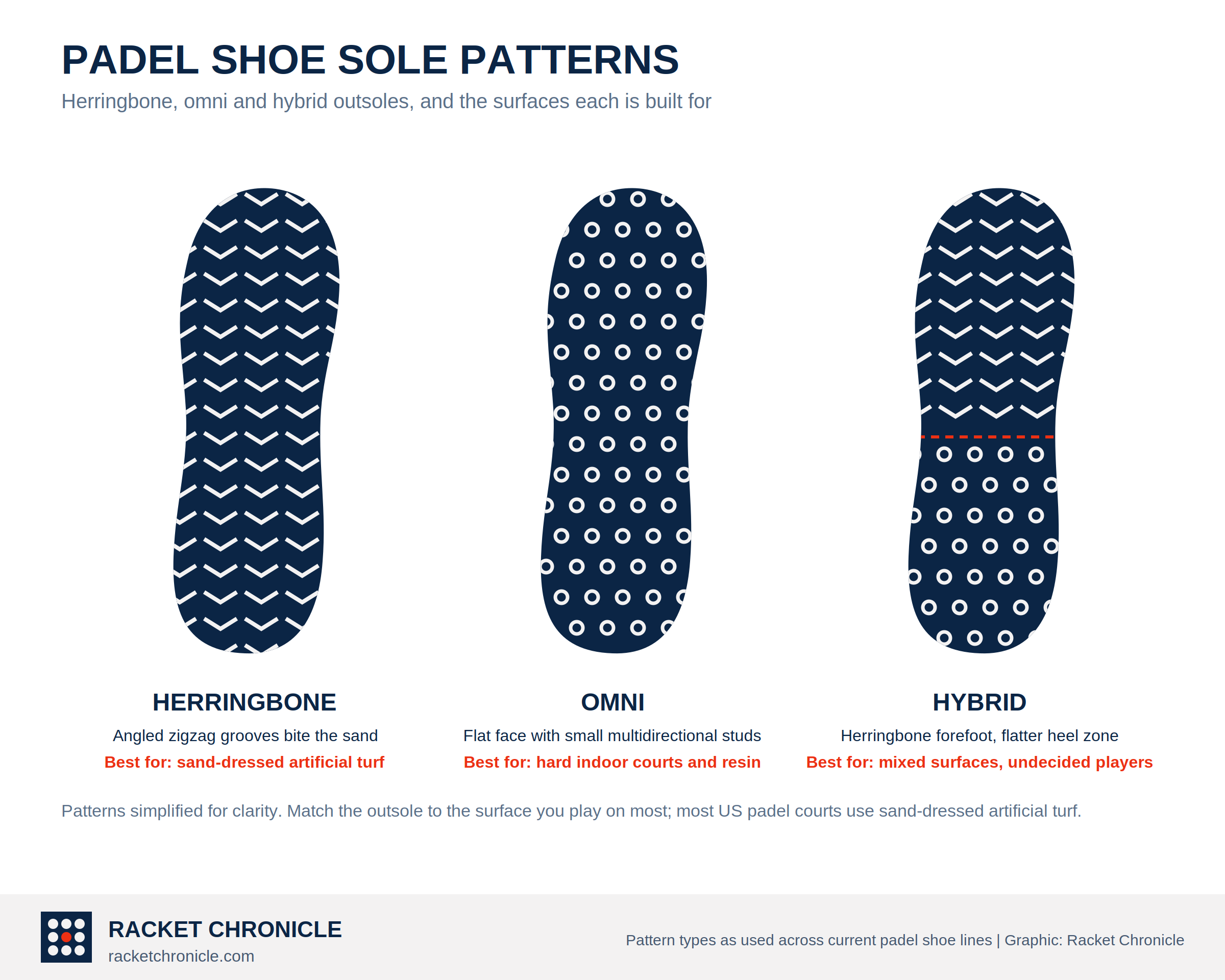
A herringbone outsole, cut in the same angled zigzag pattern used on clay-court tennis shoes, is the standard recommendation for the sand-dressed artificial turf most padel is played on. The angled grooves bite into the sand infill for lateral grip while still allowing a controlled slide on stops and direction changes, which is closer to how the surface plays than a tread that grips too hard and stops a foot dead.
An omni, or dotted, outsole trades the angled grooves for a flatter surface covered in small multidirectional studs, and it's built for harder, non-sand surfaces: concrete, resin, acrylic, and the harder indoor courts some clubs run. Omni soles grip well on those surfaces but offer noticeably less bite on sand-dressed turf, where the flatter tread has nothing to dig into.
A hybrid outsole blends the two, typically herringbone through the forefoot where push-off and lateral loading happen most, with a flatter or more omni-style pattern elsewhere. It's the reasonable default for a player who splits time between outdoor sand-turf courts and harder indoor surfaces, or who doesn't yet know which surface they'll play on most, though a player who knows they're staying on one surface type is usually better served by the pattern built specifically for it.
What Should You Look For in a Padel Shoe?
Lateral stability comes first because padel's movement pattern is built almost entirely around sudden side-to-side loading rather than forward sprinting. A padel shoe's upper carries reinforcement through the midfoot and along the outer wall of the shoe specifically to keep the foot from rolling during a hard defensive step or a quick recovery toward the net, and that structure does more for injury prevention than almost any other spec on the shoe.
Grip pattern matched to surface comes next, for the reasons covered above: herringbone for sand-dressed turf, omni for harder courts, hybrid for a mix of both. Buying the wrong pattern for the surface a player actually plays on most is one of the more common and easily avoidable mistakes in padel footwear.
Toe and medial reinforcement is next, given how much toe-drag padel actually produces. Serves, defensive gets played off the back glass, and low balls played close to the wall all put repeated abrasive contact on the front and inner edge of the shoe in a way most other racket sports don't, and a shoe without a reinforced toe cap and medial wall wears through in that spot well before the rest of the shoe is done.
Cushioning and fit round out the list. Padel courts sit on a harder sub-base than a well-maintained natural surface, and a shoe with too little cushioning transmits more of that impact up through the foot and ankle over a long session. Fit follows the same logic as any athletic shoe: a snug midfoot and heel with enough room in the toe box to avoid bruising on hard stops, since the foot slides forward under braking the same way it does in tennis.
These priorities show up as named technology in current shoe lines rather than staying abstract. Racket Central describes Babolat's competition-level padel shoes as built around a Michelin-developed outsole with what the brand calls 360 Flex Technology, paired with a woven upper for structural support around the midfoot, while its club-level models carry a separate midfoot lockdown system at a more accessible price point. That kind of tiering, a flagship outsole compound and support structure at the top of a line, a simpler version of the same idea further down, is typical of how the checklist above actually gets built into a shoe rather than staying a list of abstract priorities.
How Much Do Padel Shoes Cost?
Padel shoes run roughly $90 to $180 at current US retailers. Tennis Warehouse's padel shoe listings, checked in August 2026, span from the adidas CourtQuick Padel at $89.95 and the K-Swiss Ultrashot Lt Padel at $90.00 up to the adidas CrazyQuick Boost at $179.95 and the Babolat Premura 3 Lebron at $180.00, with the Asics Gel Resolution X Padel, Babolat Movea 2, and Lacoste Ultra Padel filling the middle of that range between roughly $130 and $165. Racket Central's shoe listings, checked the same month, run from about $90 to $160 across adidas, Babolat, and K-Swiss models, a similar band from a second retailer.
Neither retailer showed a meaningfully cheaper entry tier than the other once clearance and reduced listings were set aside; the roughly $90 to $100 floor and $160 to $180 ceiling held consistently across both. Reduced and clearance listings occasionally drop below that floor, Tennis Warehouse's clearance section has carried clay-crossover models under $90, but those reflect discounted stock rather than a reliable price point to plan around.
How Long Do Padel Shoes Last?
No governing body or manufacturer publishes an official lifespan figure for a padel shoe. What does exist is a set of physical signs that a shoe is done: a smoothed-out outsole where the herringbone or omni pattern has worn flat and lost its bite, a compressed midsole that no longer springs back and leaves the foot feeling every hard stop, and a torn or worn-through toe guard from repeated drag on serves and wall play.
Tennis Warehouse operates a published six-month outsole durability guarantee, a one-time replacement pair if the outsole wears through within six months of purchase, but the program's own pages document it against the retailer's tennis shoe lines specifically. It could not be confirmed at writing time whether the guarantee extends to the retailer's separately listed padel shoe models, so it's worth checking a specific listing before buying on the strength of that guarantee.
Player-reported lifespan, which shows up consistently across padel coaching and retail sites without ever being an official figure, tends to land around six to twelve months of regular play, roughly two to three sessions a week, before the outsole is visibly worn. That range shortens for players who play more often or whose game involves heavy wall play and toe-drag, and it lengthens for players on a softer, better-maintained court surface.
Padel Shoes: FAQs
Can you play padel in running shoes?
Can you wear padel shoes for tennis or pickleball?
Do you need different shoes for indoor padel?
Sources
International Padel Federation, "Rules of Padel," Review of application 01.01.2026
Tennis Warehouse, "Padel Shoes," accessed August 2026
Racket Central, "Padel Shoes," accessed August 2026
Mondo Worldwide, "Padel: Perfect Surfaces for All Playing Environments," accessed August 2026