

Padel Court Guide: Layout, Surface and Design
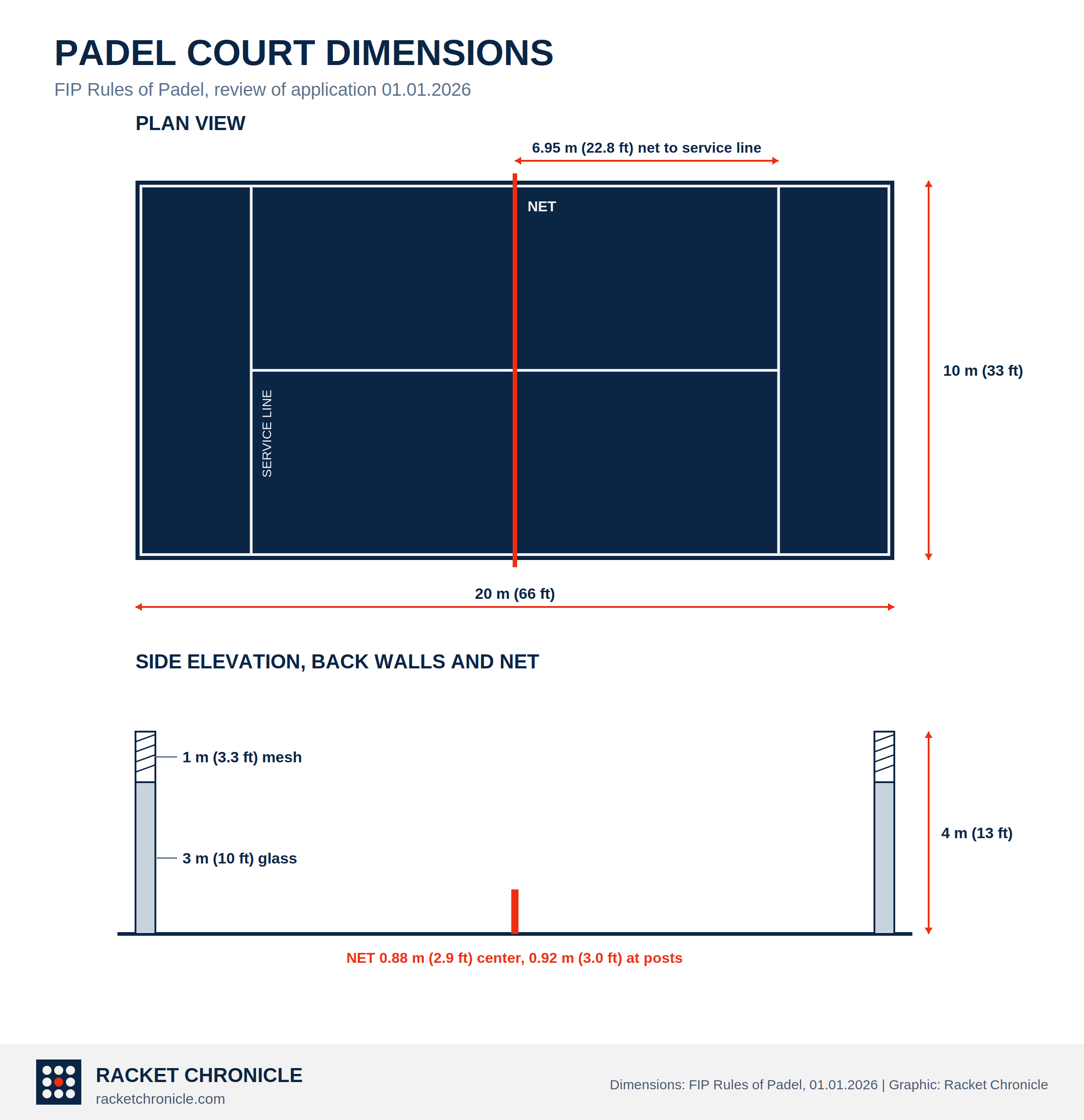
A padel court is an enclosed rectangle, 20 meters long and 10 meters wide (66 by 33 feet), where glass and mesh walls are part of live play rather than boundary markers. Almost every court is floored with sand-dressed artificial turf, the surface that has become close to standard for the sport in practice.
- A padel court is a fully enclosed 20 by 10 meter (66 by 33 foot) rectangle where the glass and mesh walls stay in play.
- The playing surface is almost always sand-dressed artificial turf, though FIP’s own rules permit cement or other synthetic surfaces too.
- Courts come indoor, outdoor, and covered outdoor, plus a panoramic design variant built for sightlines rather than a different sport.
What Is a Padel Court?
A padel court is an enclosed structure built for doubles play, where the surrounding glass and mesh walls are part of the game rather than a line the ball must stay inside. Padel is played by returning the ball off those walls after it bounces on the floor, which is the single structural fact that shapes everything else about how a padel court gets built.
The court measures 20 meters long and 10 meters wide, under the FIP Rules of Padel, Review of application 01.01.2026, enclosed on all sides so a ball in play never fully leaves the court. Official measurements extend past that footprint to net heights, service box layout, and access door widths, all set out in the padel court dimensions annex of the rulebook.
The enclosure itself runs about 4 meters (13 feet) high at the ends, typically 3 meters (10 feet) of glass topped with a meter (3 feet) of metal mesh, with the side walls stepping down toward the net. That physical structure, not the court’s footprint alone, is what separates padel from every other racket sport played inside a comparably sized space.
What Are Padel Courts Made Of?
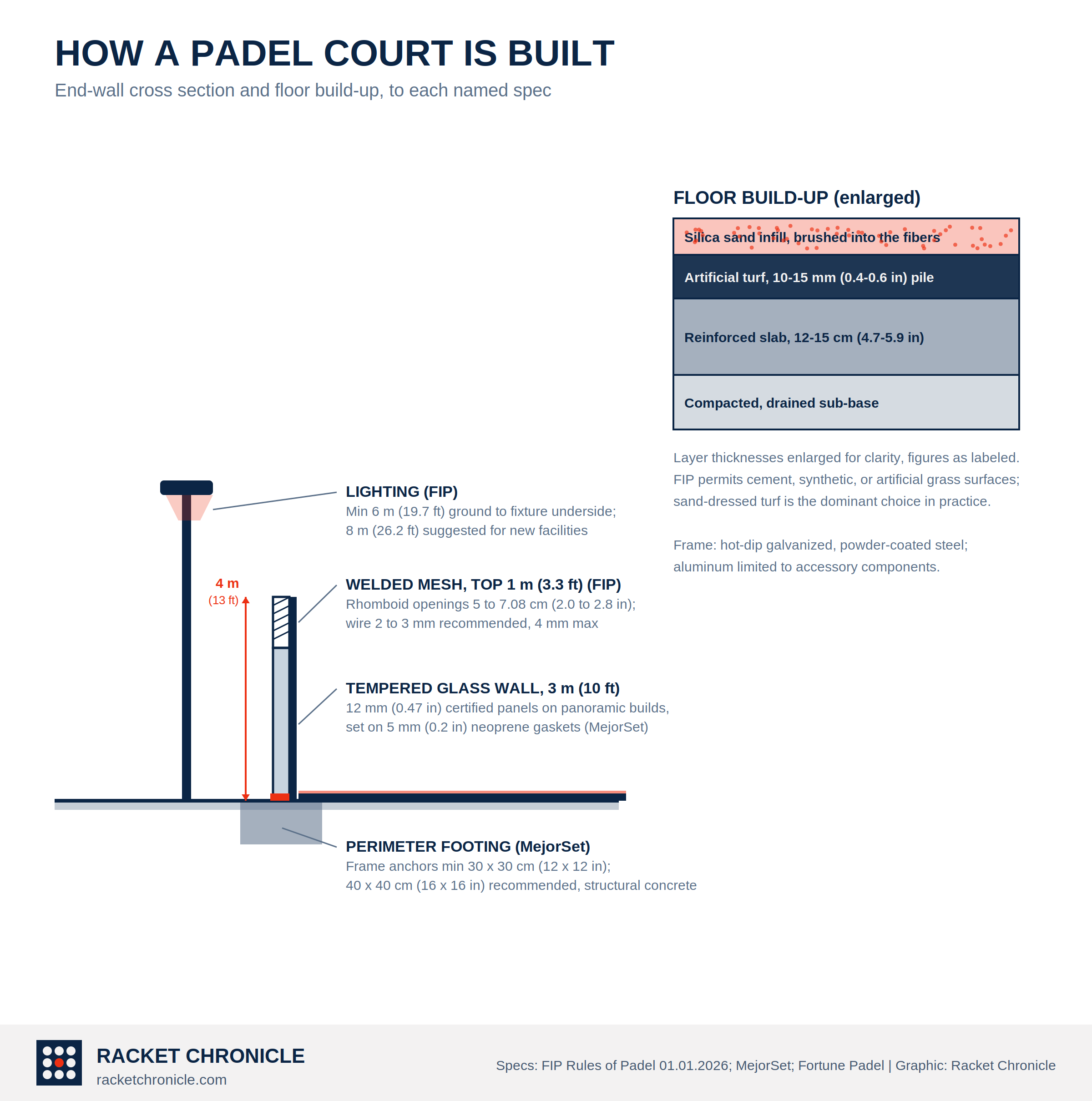
The structural frame is almost always steel, usually hot-dip galvanized and powder coated to resist corrosion, since a padel enclosure sits outdoors as often as it sits under a roof. MejorSet, a Spanish court manufacturer, coats its steel elements with a QUALICOAT-certified polyester powder finish and adds an additional epoxy primer layer for coastal or high-salinity sites, the kind of detail that separates a court built to last from one that corrodes within a few seasons. Some accessory components, net posts and cross members among them, are built from aluminum instead, but the load-bearing frame is steel in the large majority of installations.
The walls are tempered glass, and thickness is not a detail worth guessing at. MejorSet specifies 12 millimeter (0.47 inch) certified tempered glass for its panoramic back walls and sides, installed on 5 millimeter (0.2 inch) neoprene gaskets to absorb vibration and reduce breakage, manufactured to the European tempered-glass standard UNE-EN 12150-1. Sodex Sport, another court manufacturer, lists 10 millimeter (0.39 inch) tempered glass on its standard indoor court, the lighter specification reserved for non-panoramic installations while 12 millimeter is kept for the larger panoramic panels that carry more load.
Above the glass, FIP’s Rules of Padel specify the mesh precisely: a welded, diamond-pattern fence with openings between 5 and 7.08 centimeters (2.0 and 2.8 inches) across and wire with a recommended thickness of 2 to 3 millimeters (0.08 to 0.12 inches), with a 4 millimeter (0.16 inch) maximum, forming the top meter of the court’s 4 meter (13 foot) total wall height.
The playing surface itself has more official flexibility than most players assume. FIP’s rulebook permits a court floor of cement, synthetic material, or artificial grass, provided it gives a regular ball bounce, without mandating any one of the three. In practice, sand-dressed artificial turf has become close to the standard choice, a shift documented by Mondo Worldwide, an international sports-surface manufacturer, as the industry’s default for both outdoor and most indoor installations.
The turf itself is a specific product, not generic landscaping grass. Fortune Padel builds its padel-specific turf around short, dense fibers, typically 10 to 15 millimeters (0.4 to 0.6 inches) of pile height, with monofilament or crimped monofilament yarns favored over the older fibrillated style for the more consistent ball response and multidirectional traction they provide. Higher stitch density translates directly into a more consistent surface: a sparse, low-density turf lets the sand shift and the fibers mat down faster, while a denser weave holds its shape and its sand loading for longer under repeated play.
None of that sits on bare ground. MejorSet specifies a foundation with two distinct parts: a perimeter footing where the frame anchors, with anchor points no smaller than 30 by 30 centimeters (11.8 by 11.8 inches), recommended at 40 by 40 centimeters (15.7 by 15.7 inches), set in structural concrete, and a playing-area slab of 12 to 15 centimeters (4.7 to 5.9 inches) of reinforced concrete beneath the turf itself. A foundation that skips either spec doesn’t just risk cosmetic problems: an uneven slab shows up directly in ball bounce and player footing, and an undersized frame anchor becomes a genuine safety issue the first time a player collides with the glass at speed.
Why Do Padel Courts Have Sand?
Padel courts have sand because artificial turf alone cannot support the game padel is built around. Silica sand, brushed into the turf fibers after installation, keeps those fibers standing upright rather than matting flat under repeated foot traffic, which is what gives the surface a consistent, predictable ball bounce match after match.
The sand does three more jobs beyond holding the fibers up. Fortune Padel, a court and turf manufacturer, describes the infill as acting like a cushion that reduces the strain a hard sub-base would otherwise put on a player’s joints, while also improving traction underfoot for the constant lateral movement padel demands. On outdoor courts, sand-dressed turf paired with a permeable sub-base drains rainwater quickly enough that a court is playable again shortly after a storm, rather than staying waterlogged the way a solid surface would.
That same sand is why padel shoes carry a herringbone or omni outsole rather than a standard trainer’s tread: the tread pattern exists specifically to grip through a sand layer sitting on top of turf fibers, a surface that behaves nothing like a hard court or natural grass.
The sand also needs upkeep to keep doing its job. Turf manufacturers commonly recommend brushing a heavily used court once or twice a week to redistribute sand that shifts during play and to keep the fibers standing upright rather than flattened, along with periodic infill replenishment as sand levels gradually drop from normal wear. A court that skips this maintenance doesn’t fail outright, but its bounce and grip both drift away from what the surface was built to deliver, which is part of why well-run clubs treat sand upkeep as routine rather than occasional.
What Is the Difference Between Indoor and Outdoor Padel Courts?
Indoor and outdoor padel courts differ mainly in what the environment does to the game rather than in the court’s core dimensions, which stay the same either way. Ceiling clearance counts for more indoors: FIP’s Rules of Padel set a minimum height of 6 meters (19.7 feet) throughout the court, with 8 meters (26.2 feet) suggested for new facilities, specifically because a padel lob needs room to clear without hitting an overhead beam or light fixture, a constraint outdoor courts never face.
Wind and weather are the outdoor trade-off. An outdoor ball’s flight is affected by wind in a way an indoor point never is, and outdoor turf and glass are built to handle direct sun, rain, and temperature swings that indoor installations are shielded from entirely, which is also why outdoor turf needs UV-stabilized fibers an indoor court doesn’t require. Lighting works in the opposite direction: an indoor court runs on artificial light for every session regardless of the hour, while an outdoor court depends on its lighting system only after dark.
A covered outdoor court sits between the two: walls open to the air the way a standard outdoor court’s do, but a roof removes rain and direct sun as a factor without controlling wind the way a sealed indoor hall does. For a club comparing the investment, a covered court is often the practical middle ground, weather protection without the full cost of an enclosed building.
Wear and maintenance follow the same split. An indoor court’s turf and glass are shielded from UV exposure and precipitation entirely, which slows the gradual fading and fiber breakdown that sun exposure causes outdoors and generally stretches the interval between resurfacing. An outdoor court needs more frequent brushing and sand replenishment to counter wind-driven sand loss and faster fiber wear, and its glass needs regular cleaning to clear the mineral buildup rain leaves behind, upkeep an indoor court rarely faces to the same degree.
What Is a Panoramic Padel Court?
A panoramic padel court replaces the standard multi-panel back and side walls with fewer, larger glass panels and no corner posts, so a spectator’s view of the court is unbroken by frame lines. MejorSet’s own panoramic design uses side panels measuring 2 by 3 meters (6.6 by 9.8 feet) each, built specifically to eliminate the corner pillars a standard court’s smaller panel sections require.
The design exists for sightlines and broadcast more than for gameplay itself. A panoramic back wall lets a courtside camera or a row of spectator seating see the full width of play without a support post cutting across the frame, which is why the format shows up most often at clubs built with spectating or content creation in mind rather than at purely recreational facilities.
That visibility comes with a structural cost. Larger glass panels need to be thicker to carry the same load a smaller, frame-supported panel would otherwise share, which is part of why 12 millimeter glass, rather than the 10 millimeter used on many standard courts, is common on panoramic installations. The larger panels also cost more to manufacture, ship, and install than a run of smaller standard panels, a cost difference that shows up directly in what a panoramic build runs a club compared with a standard enclosure.
In practice, panoramic construction shows up most on flagship or single-court installations, a club’s centerpiece court, a hotel or resort amenity, a venue built around streaming matches, rather than across every court at a multi-court facility. A club adding several courts at once will often mix standard enclosures for the bulk of its capacity with one panoramic court reserved for exhibition matches, filming, or its best-paying members, rather than building every court to the panoramic spec.
What Lighting Does a Padel Court Need?
FIP’s Rules of Padel say less about lighting than most players assume. The rulebook requires artificial light to be uniform and positioned so it doesn’t interfere with players’, officials’, or spectators’ vision, sets a minimum pole height of 6 meters (19.7 feet) from the ground to the bottom of the light fixture, and recommends 8 meters (26.2 feet) for new facilities. The only specific brightness figure in the document is for broadcast: a minimum of 1000 lux for television or film recording. FIP does not set a lux target for ordinary recreational or club play.
That gap gets filled by manufacturers rather than the governing body. Lighting vendor guidance commonly targets roughly 200 to 300 lux for recreational play, 300 to 500 lux for club and league use, and 500 lux or more for competition or broadcast-adjacent courts, figures drawn from general sports-lighting practice and vendor experience rather than an FIP mandate. A club researching lighting for a new or renovated court should treat these ranges as informed manufacturer recommendations rather than official rule compliance, since no single official standard actually governs how bright a recreational padel court needs to be.
Fixture placement is as important as raw brightness. Poorly positioned floodlights create glare off the glass walls that makes a lobbed ball genuinely hard to track, which is why dedicated padel lighting fixtures, built with narrower, more controlled beam angles than a general-purpose floodlight, are commonly recommended over repurposed outdoor lighting.
Uniformity and color rendering count alongside the raw lux number. A court lit to a high average brightness can still play poorly if that light isn’t distributed evenly, since dark corners and bright hotspots make it harder to judge the ball’s position than a dimmer, more even court would. Lighting vendors commonly reference a uniformity ratio, the minimum illuminance divided by the average, alongside a color rendering index high enough that players can track a moving ball clearly rather than see it as a flat silhouette against the glass. Neither figure appears in FIP’s own rulebook text; both come from general sports-lighting practice that manufacturers apply to padel courts by design convention rather than federation mandate.
Can You Buy or Build a Padel Court?
A padel court can be purchased as a prefabricated kit: manufacturers ship the steel frame, tempered glass panels, wire mesh, net and posts, and often the artificial turf itself as manufactured components, designed for a contractor or the supplier’s own crew to assemble on a prepared site rather than built from raw materials on location. Installation timelines and exactly what’s included both vary supplier to supplier, from a few weeks for a standard outdoor build to considerably longer for larger or panoramic installations.
Building a padel court is a real construction project, not a weekend installation, whether the enclosure itself arrives as a kit or is assembled panel by panel on site. It involves site preparation and a compliant sub-base before the frame goes up, drainage planning for outdoor sites, electrical work for lighting, and often local permitting depending on the jurisdiction and whether the structure counts as a permanent building. Most builds involve a licensed contractor rather than a DIY effort for exactly those reasons. Construction costs vary by region, surface choice, and court type.
Padel Court FAQs
How many padel courts fit on a tennis court?
Roughly three. A padel court’s playing surface is smaller than a tennis court’s, but the more useful comparison is footprint: accounting for the run-off space each sport needs around its playing lines, about three padel courts fit in the space required for one regulation tennis court.
How many padel courts are there in the US?
Just over 1,000, spread across roughly 31 to 37 states, according to the United States Padel Association’s own April 2026 figures. That count is growing quickly enough that any specific number will likely be understated by the time it’s read; the USPA itself projects the US could reach 10,000 courts by 2030 if current growth holds.
Where can you find a padel court to play on?
Club booking platforms are the most direct route in most US markets, since the large majority of padel courts sit inside private or semi-private clubs rather than open public parks the way pickleball courts often do. The United States Padel Association maintains its own national club directory, part of its effort to route new players toward courts as the sport’s US footprint keeps growing, and most individual clubs also list availability through their own booking systems or general racket-sport booking apps.
Sources
International Padel Federation, “Rules of Padel,” Review of application 01.01.2026
MejorSet, “FIP Official Padel Court,” accessed August 2026
Mondo Worldwide, “Padel: Perfect Surfaces for All Playing Environments,” accessed August 2026
Fortune Padel, “Artificial Turf: The Top Choice for Padel Courts,” accessed August 2026
Image: Depositphotos