

Padel Court Dimensions: Official Size in Feet and Meters
A regulation padel court measures 20 meters long and 10 meters wide (65.6 by 32.8 feet) on the interior, with a 0.5 percent tolerance allowed either way. Every other figure on the court, service lines, wall heights, net height, follows from the same rulebook rather than varying by manufacturer or region.
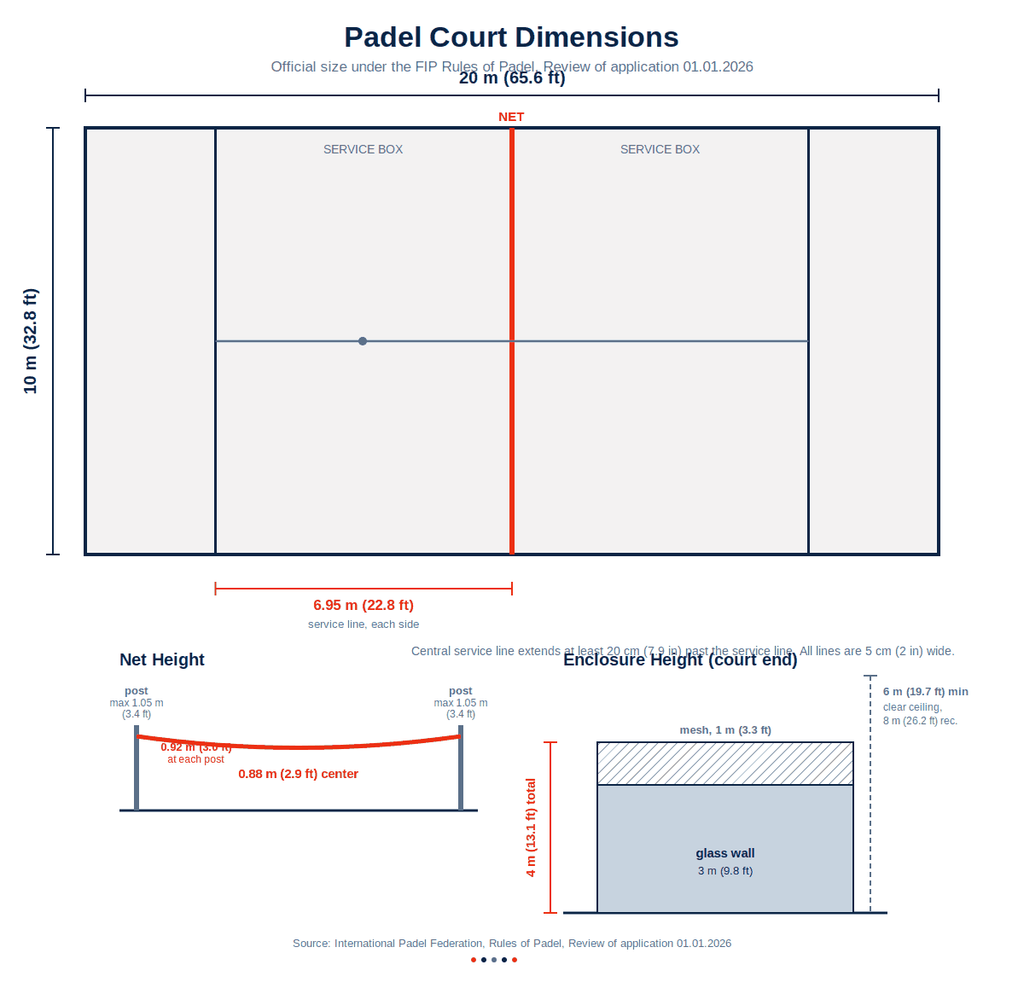
- The court measures 20 by 10 meters (65.6 by 32.8 feet), interior dimensions, with a 0.5 percent tolerance.
- The enclosure runs 4 meters (13.1 feet) high at the ends, and overhead clearance across the whole court must be at least 6 meters (19.7 feet), 8 meters (26.2 feet) recommended for new facilities.
- There is no separate court size for singles; the current rulebook defines only one dimension, built for doubles.
What Are the Official Dimensions of a Padel Court?
A regulation padel court measures 10 meters wide by 20 meters long (32.8 by 65.6 feet), measured from the interior of the walls, under the FIP Rules of Padel, Review of application 01.01.2026. A tolerance of 0.5 percent is allowed either way, which accounts for minor construction variance without making a court non-compliant. Padel is played entirely within this enclosed rectangle, and the glass and mesh enclosure that enables that play is built from tempered glass panels and welded metal mesh rather than open fencing, a construction choice that gives the ball a uniform, predictable bounce off every surface.
The service line sits 6.95 meters (22.8 feet) from the net on each side, dividing the court into the back court and the service area. A central service line splits that service area into two equal halves and extends at least 20 centimeters (7.9 inches) beyond the service line itself. Every line on the court, including these, must be 5 centimeters (2 inches) wide, and the two halves of the court must be identical in area and marking.
Surface color is regulated alongside the layout. FIP lists green, blue, and terracotta as the permitted and preferred single-color surfaces, with a requirement that the playing surface contrast clearly against the wall color so the ball stays visible throughout a rally. For outdoor facilities, the rulebook also recommends orienting the court’s long axis north to south, allowing a variation between north-northeast and north-northwest, a detail aimed at limiting how much direct sun players face during a match rather than a strict compliance requirement.
How High Are the Walls and Enclosure?
The end walls run 4 meters (13.1 feet) high in total: the first 3 meters (9.8 feet) is wall, glass or another solid, transparent material meeting FIP’s tempered-glass standard, and the top meter (3.3 feet) is metallic mesh fence.
The side enclosures follow one of two accepted configurations under the current rulebook, and the two are structurally different rather than variations on the same shape. The first steps the wall down in two stages at each end, 3 meters (9.8 feet) high for the first 2 meters (6.6 feet) of length, then 2 meters (6.6 feet) high for the next 2 meters, with metal mesh fencing completing the enclosure to 3 meters through the center stretch of the side and up to 4 meters at both ends. The second, which the rulebook itself labels the Crystal variant, uses no step at all: a single 3 meter (9.8 feet) high wall section runs the full 4 meters (13.1 feet) of length at each end zone, with mesh completing the height to 4 meters (13.1 feet) over the final 2 meters (6.6 feet). Either configuration is compliant; the choice is a construction decision rather than a rule requirement.
Overhead clearance is a separate figure from wall height, and it counts for just as much in how the sport actually plays. FIP sets a minimum unobstructed height of 6 meters (19.7 feet) across the entire court, with 8 meters (26.2 feet) suggested for new facilities, specifically so a padel lob has room to clear without hitting a beam or light fixture.
Access points and the safety area around the enclosure carry their own dimensions too. A court with one access opening per side needs an opening between 1.05 by 2.0 meters (3.4 by 6.6 feet) minimum and 2.20 by 2.20 meters (7.2 by 7.2 feet) maximum; with two access openings per side, each opening runs between 0.72 by 2.00 meters (2.4 by 6.6 feet) minimum and 1.10 by 2.20 meters (3.6 by 7.2 feet) maximum. For a court to authorize out-of-court play, the rulebook also requires an obstacle-free area outside the enclosure measuring at least 3 meters (9.8 feet) wide, 4 meters (13.1 feet) recommended, 4 meters (13.1 feet) long, and a minimum of 3 meters (9.8 feet) high on each side, which is why not every court, even a regulation one, automatically permits players to leave the court to chase a ball.
The metallic mesh that completes the enclosure above the glass has its own dimensional spec too. FIP requires a welded, diamond-pattern fence with openings between 5 and 7.08 centimeters (2.0 and 2.8 inches) across, using wire with a recommended thickness of 2 to 3 millimeters (0.08 to 0.12 inches) and a 4 millimeter (0.16 inch) maximum, tensioned so the mesh still gives the ball a usable, if duller, bounce rather than simply absorbing it.
How High Is the Net in Padel?
A padel net measures 0.88 meters (2.9 feet) high at the center and rises to 0.92 meters (3.0 feet) at the posts, with a small tolerance allowed at each point. The net posts themselves can stand no taller than 1.05 meters (3.4 feet), and the net must be capped with a white strip 5.0 to 6.3 centimeters (2.0 to 2.5 inches) wide covering the tension cable beneath it.
The posts sit at the outer edge of the court, coinciding with the lateral limits set by the enclosure, and the net’s tensioning mechanism is required to hold that shape reliably rather than loosen mid-match: the rulebook specifies that whatever cable or fitting tensions the net must be designed so it cannot slacken unexpectedly during play. The net itself must run fully extended between the two posts with no gap between its lower edge and the court surface, since a gap there would let the ball pass underneath rather than over it.
Is There a Different Padel Court Size for Singles?
No. The current FIP Rules of Padel define only one court dimension, 20 by 10 meters, built for doubles, and a direct check of the rulebook’s court and format sections for this article found no separate singles dimension defined anywhere in it. Some secondary sources describe an official narrower singles court, but that claim doesn’t appear in the current rulebook text, the same conclusion already reached on Racket Chronicle’s how-to-play guide.
Informal one-on-one play does happen at some clubs, typically played on a standard doubles court with the side corridors treated as out of bounds, but it’s a casual variation rather than a codified format with its own official dimensions.
How Does a Padel Court Compare in Size to Tennis and Pickleball?
A doubles tennis court measures 23.77 by 10.97 meters (78 by 36 feet) under the ITF’s Rules of Tennis, and a singles court narrows to 23.77 by 8.23 meters (78 by 27 feet); both run longer than a padel court and, in the doubles case, come close in width despite tennis having no enclosing walls at all. In raw area, a doubles tennis court works out to about 261 square meters (2,808 square feet) against a padel court’s 200 square meters (2,153 square feet), roughly a quarter smaller, even though the two courts read as similarly sized at a glance. A padel court’s defining difference from tennis isn’t really its footprint, though, it’s the enclosure: every wall and mesh panel on a padel court is part of live play, which a tennis court’s boundary lines never are.
A pickleball court measures 13.41 by 6.10 meters (44 by 20 feet) under USA Pickleball’s official rules, an area of about 82 square meters (880 square feet), noticeably smaller than either padel or tennis and, like tennis, entirely open with no enclosing walls. Padel versus pickleball comes down to more than court size: pickleball’s non-volley kitchen zone and padel’s live walls are structural features neither sport’s court shares with the other, despite both being compact compared with tennis.
Padel Court FAQs
How big is a padel court?
A padel court measures 200 square meters (2,153 square feet) of interior playing surface, 20 meters by 10 meters (65.6 by 32.8 feet), enclosed on all sides by glass and mesh walls that are part of live play. That figure covers the playing surface itself; the total footprint needed to build a court, including safety areas and access points around the enclosure, runs larger still.
What is the height of a padel court?
The enclosure itself runs 4 meters (13.1 feet) high at the ends, but the more important figure for play is overhead clearance: FIP requires at least 6 meters (19.7 feet) of unobstructed height across the whole court, with 8 meters (26.2 feet) recommended for new facilities, room enough for a full lob to clear without touching a ceiling, beam, or light fixture.
Is a padel court bigger or smaller than a tennis court?
Smaller in length and close in width to a doubles tennis court, but the more meaningful difference is the enclosure. A tennis court has no walls in play at all, while every surface of a padel court’s glass and mesh enclosure is part of the game.
Do padel courts have different sizes for singles and doubles?
No. The current FIP rulebook defines only one court size, covered in full above.
Sources
International Padel Federation, “Rules of Padel,” Review of application 01.01.2026
International Tennis Federation, “Rules of Tennis,” Rule 1: The Court
Image: Depositphotos