

Pickleball Court Dimensions and Net Height
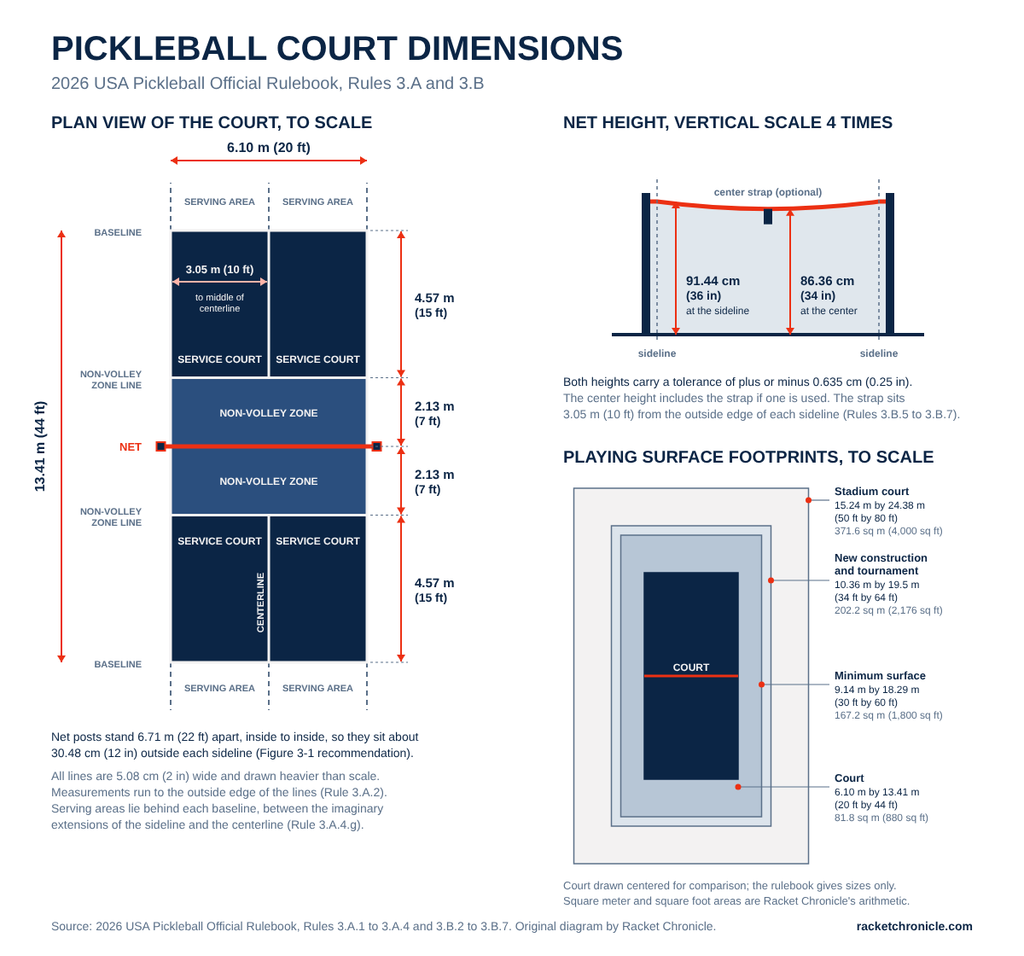
A pickleball court is a rectangle 6.10 m wide and 13.41 m long (20 ft by 44 ft), the same for singles and doubles and measured to the outside edge of the lines, and the net is 91.44 cm (36 in) high at the sidelines and 86.36 cm (34 in) at the center. The playing surface around the court is at least 9.14 m by 18.29 m (30 ft by 60 ft), with larger sizes recommended for new construction, tournament play and stadium courts. The figures come from the 2026 USA Pickleball Official Rulebook unless a sentence names another source, and every area total is Racket Chronicle’s arithmetic.
- The court is 6.10 m by 13.41 m (20 ft by 44 ft) for singles and doubles, with the net at 91.44 cm (36 in) at the sidelines and 86.36 cm (34 in) at the center.
- A non-volley zone 2.13 m (7 ft) deep sits on each side of the net, and the centerline splits the rest of each end into a right and a left service court.
- The minimum playing surface is 9.14 m by 18.29 m (30 ft by 60 ft), and the rulebook recommends 10.36 m by 19.5 m (34 ft by 64 ft) for new construction and tournaments and 15.24 m by 24.38 m (50 ft by 80 ft) for stadium courts.
How Big Is a Pickleball Court?
Pickleball is played on one court size. The rulebook requires a rectangle 6.10 m wide and 13.41 m long (20 ft by 44 ft) and applies it to singles and doubles alike, so the same lines serve a two-player game and a four-player game. The width runs along each baseline and the length runs from one baseline to the other across the net.
Court measurements are made to the outside edge of the perimeter lines and the non-volley zone lines. That puts the lines inside the 6.10 m (20 ft) and 13.41 m (44 ft) figures, so each line is part of the court.
Racket Chronicle’s arithmetic from those two rulebook figures puts the area at about 81.8 square meters (880 square feet). The metric sides give it directly, 6.10 m multiplied by 13.41 m, and the feet sides give 20 ft multiplied by 44 ft, which converts at 0.09290304 square meters per square foot to the same 81.8. A padel court is larger and enclosed: the International Padel Federation’s Rules of Padel, in the review of application dated January 1, 2026, set interior measurements of 10 m by 20 m (32.8 ft by 65.6 ft), which is 200 square meters (about 2,153 square feet), and require the court to be completely enclosed.
What Are the Lines and Areas of a Pickleball Court?
Four kinds of line mark the court. The baselines are the lines parallel to the net at each end, and the sidelines are the two lines that bound the court perpendicular to the net and the baselines. The non-volley zone line runs parallel to the net, 2.13 m (7 ft) from the net on each end, between the two sidelines. The centerline runs down the middle of each end of the court from the non-volley zone line to the baseline, and it separates the right and left service courts. Each line is part of the court, so a ball that touches a line is in, except for a serve that touches the non-volley zone line. The rulebook says all lines should be 5.08 cm (2 in) wide and the same color, clearly contrasting with the color of the playing surface and court. The word is “should” in the rulebook, not “must”, so line width and color are a specification rather than a requirement.
The non-volley zone is the area of the court on each side of the net, 2.13 m deep and 6.10 m wide (7 ft by 20 ft). The rulebook prints the metric width as 6.08 m, but 20 ft converts to 6.10 m, the court width this page uses. All lines that bound the zone are part of the zone, and the zone is two-dimensional: it does not extend above the playing surface. USA Pickleball’s Rules Summary adds that the zone is commonly called the kitchen. The two zones together cover 4.27 m (14 ft) of the 13.41 m (44 ft) length, converted from the feet figures.
The service courts are the areas on each end between the non-volley zone and the baseline, on either side of the centerline. Each right and left service court is bounded by and includes its adjacent baseline, sideline and the centerline. The rulebook’s court figure gives each service court as 3.05 m (10 ft) wide, measured to the middle of the centerline, and 4.57 m (15 ft) long. Racket Chronicle’s check in feet: two non-volley zones of 7 ft and two service court depths of 15 ft add up to the full 44 ft (13.41 m) length.
The serving areas are the areas behind the baseline on each end. The right and left serving areas are bounded by and include the imaginary extensions of the adjacent sideline and the centerline. The server serves diagonally from the serving area behind the baseline into the opposite service court.
How High Is a Pickleball Net?
The top of the net must be 91.44 cm (36 in), plus or minus 0.635 cm (0.25 in), above the playing surface where the net crosses the outer edge of the sidelines. At the center point of the court it must be 86.36 cm (34 in), plus or minus 0.635 cm (0.25 in). Those tolerances allow 90.805 cm to 92.075 cm (35.75 in to 36.25 in) at the sidelines and 85.725 cm to 86.995 cm (33.75 in to 34.25 in) at the center, by Racket Chronicle’s arithmetic. The center height measurement includes the center strap if one is used.
The strap is optional. When it is used, it is centered 3.05 m (10 ft) from the outside edge of the sidelines, which is the middle of the 6.10 m (20 ft) court width, and its purpose in the rulebook’s wording is to adjust the net to the required center height. The center height is 5.08 cm (2 in) lower than the sideline height, by Racket Chronicle’s arithmetic.
The rest of the net system is specified more loosely. The net can be made of any mesh fabric that does not let a ball pass through. Its length should be at least 6.63 m (21 ft 9 in), measured from one post to the other, and its height from the bottom edge to the top should be at least 76.2 cm (30 in). The top of the net should be edged with a 5.08 cm (2 in) white tape binding over a cord or cable running through the binding, and the binding must rest upon the cord or cable.
Net posts should stand 6.71 m (22 ft), plus or minus 2.54 cm (1.0 in), apart, measured from the inside of one post to the inside of the other, and the maximum diameter of a post should be 7.62 cm (3 in). The rulebook’s court figure also recommends that net posts extend 30.48 cm (12 in) outside the sideline. The rulebook words the two net heights as requirements (“must”) and the post spacing, post diameter, net length and tape width as “should”.
How Much Space Does a Pickleball Court Need?
The rulebook sets a minimum playing surface of 9.14 m wide and 18.29 m long (30 ft by 60 ft). That surface is 3.05 m (10 ft) wider and 4.88 m (16 ft) longer than the 6.10 m by 13.41 m (20 ft by 44 ft) court inside it, and Racket Chronicle’s arithmetic puts its area at about 167.2 square meters (1,800 square feet). Square meter figures convert from the square-foot total and round to one decimal place.
The rulebook lists recommendations for larger surfaces. New construction and tournament play both take 10.36 m by 19.5 m (34 ft by 64 ft), which is about 202.2 square meters (2,176 square feet). A stadium court takes 15.24 m by 24.38 m (50 ft by 80 ft), which is about 371.6 square meters (4,000 square feet). Wheelchair play has its own recommendation in Rule 25.A.11, a playing surface 13.41 m wide and 22.55 m long (44 ft by 74 ft), with the same 15.24 m by 24.38 m (50 ft by 80 ft) for a wheelchair stadium court. The rulebook lists no separate size for backyard courts.
Outdoor courts have an orientation recommendation that the rulebook does not carry. USA Pickleball’s Court Construction, Lighting and Shading page, published September 19, 2025 and modified May 5, 2026, says courts should be oriented north to south outdoors so that players avoid looking directly into the sun in morning or late-afternoon play, which the page calls a common safety hazard.
Is the Court Different for Singles, Indoor or Half-Court Play?
Singles and doubles use the same court. The rulebook gives the 6.10 m by 13.41 m (20 ft by 44 ft) rectangle for both, and USA Pickleball’s Rules Summary says the same court size and basic rules apply to both styles of play. A singles court is not a narrower court, and a doubles court is not a wider one. The rulebook states the court dimensions once and gives no separate indoor size.
Mini-singles is the rulebook’s half-court format, listed in its section on variations on standard pickleball. It is played on a standard pickleball court, and only the right or left side on each player’s end is in play for a rally, based on each player’s score. The boundary lines of the in-play side are the baseline, the respective sideline and the centerline, and the opposite side is out of bounds. The format requires one additional line, extending the centerline through each non-volley zone, and that line does not need to match the color of the other court lines.
“Skinny singles” is not a rulebook term, but a USA Pickleball news item titled “USA Pickleball Announces Two New Sanctioning Formats” says mini-singles is sometimes referred to as skinny singles.
Pickleball Court Dimensions FAQs
How big is a pickleball court?
A pickleball court is a rectangle 6.10 m wide and 13.41 m long (20 ft by 44 ft), measured to the outside edge of the lines. The rulebook uses the same court for singles and doubles. Racket Chronicle’s arithmetic puts the area at about 81.8 square meters (880 square feet).
How high is a pickleball net?
The net must be 91.44 cm (36 in) high at the sidelines and 86.36 cm (34 in) high at the center, each with a tolerance of plus or minus 0.635 cm (0.25 in). The center measurement includes the center strap if one is used. The rulebook also says the net should be at least 6.63 m (21 ft 9 in) long and at least 76.2 cm (30 in) from bottom edge to top.
Is a pickleball court the same size for singles and doubles?
Yes. The rulebook requires a rectangle of 6.10 m by 13.41 m (20 ft by 44 ft) for both singles and doubles matches, and USA Pickleball’s Rules Summary says the same court size applies to both styles of play. Mini-singles also uses a standard court, with one side of each player’s end in play for a rally and an additional line extending the centerline through each non-volley zone.
How many square feet is a pickleball court?
A pickleball court is about 81.8 square meters (880 square feet), which is 20 ft multiplied by 44 ft converted to square meters. That is Racket Chronicle’s arithmetic from the rulebook’s court size. The minimum playing surface of 9.14 m by 18.29 m (30 ft by 60 ft) is about 167.2 square meters (1,800 square feet), and the recommended 10.36 m by 19.5 m (34 ft by 64 ft) surface is about 202.2 square meters (2,176 square feet).
How much space do you need for a pickleball court?
The rulebook sets a minimum playing surface of 9.14 m by 18.29 m (30 ft by 60 ft), which is about 167.2 square meters (1,800 square feet) by Racket Chronicle’s arithmetic. It recommends 10.36 m by 19.5 m (34 ft by 64 ft) for new construction and tournament play and 15.24 m by 24.38 m (50 ft by 80 ft) for stadium courts. USA Pickleball also says outdoor courts should be oriented north to south to keep players from facing the sun.
Sources
USA Pickleball, “2026 Official Rulebook”
USA Pickleball, “Pickleball Court Construction, Lighting and Shading,” modified May 5, 2026
USA Pickleball, “Essential Pickleball Rules Summary for Beginners,” modified September 28, 2026
International Padel Federation, “Rules of Padel,” Review of application 01.01.2026
Image: Depositphotos
