

Padel is played in doubles on a fully enclosed 20 by 10 meter court, where the ball stays live off glass and mesh walls, using tennis scoring and a solid stringless racket with a lower-pressure rubber ball. Pickleball is played on an open 13.41 by 6.10 meter court with no walls, using its own scoring system and a solid paddle with a perforated plastic ball, and it can be played as singles or doubles where padel is always doubles.
- Padel's court is enclosed by glass and mesh walls that stay in play; pickleball's court is open, with no walls, and about 40 percent of the area.
- Padel uses a stringless, perforated racket and a lower-pressure rubber ball; pickleball uses a solid, non-perforated paddle and a hard perforated plastic ball.
- Pickleball dominates US participation at 24.3 million players; padel's participation is larger globally, at 19.4 million to 35 million players worldwide, according to SFIA, USPA, Playtomic and PwC, and FIP's own 2026 figures.
What Is the Difference Between Padel and Pickleball?
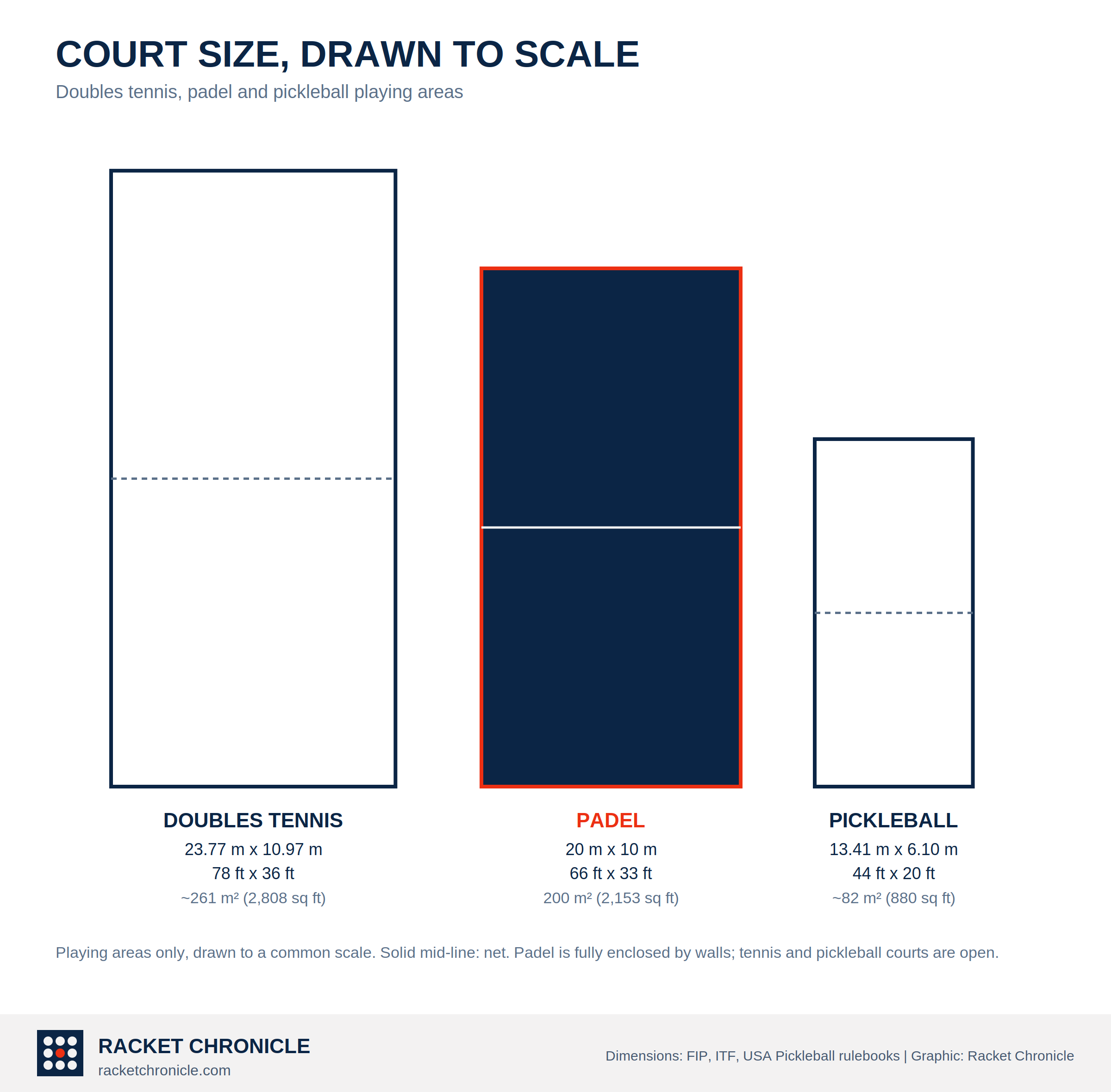
Padel and pickleball are both racket sports played on courts smaller than tennis, but the similarities mostly end there. Padel is played in doubles on a fully enclosed court, 20 meters long and 10 meters wide (66 by 33 feet), where the surrounding glass and mesh walls stay in play after the ball bounces on the floor. Pickleball is played on an open court with no enclosing walls, 13.41 meters long and 6.10 meters wide (44 by 20 feet), about 40 percent of a padel court's total area, and it can be played as either singles or doubles, while padel has no official singles format.
The equipment reflects the same split. A padel racket is solid, stringless, and perforated with small holes, capped at 45.5 centimeters (17.9 inches) long under the FIP Rules of Padel, and it strikes a lower-pressure rubber ball similar in size to a tennis ball. A pickleball paddle is also solid and stringless but has no perforation and no thickness limit under USA Pickleball's official rules, capped instead at 24 inches (60.96 centimeters) of combined length and width, and it strikes a hard, perforated plastic ball built more like an oversized wiffle ball.
Padel was invented in 1969 in Acapulco, Mexico, and its heaviest participation today is in Spain and Argentina, with the US still an early-stage growth market. Pickleball was invented in 1965 on Bainbridge Island, Washington, and the relationship is reversed: it is now the fastest-growing sport in the United States by a wide margin, while its footprint outside North America remains comparatively small. Both sports share a scaled-down, doubles-friendly format and an underarm serve, but a player who has only tried one is not prepared for what the other's court, equipment, and rules actually demand.
How Do the Courts Compare?
A regulation padel court measures 20 meters long and 10 meters wide (66 by 33 feet), under the FIP Rules of Padel, Review of application 01.01.2026. It is fully enclosed: the back walls run about 4 meters (13 feet) high, typically 3 meters (10 feet) of glass topped with a meter (3 feet) of metal mesh, and the ball stays live off those walls after it bounces on the court floor. There is no non-volley zone in padel; any part of the court can be played from, including the area closest to the net.
A regulation pickleball court measures 13.41 meters long and 6.10 meters wide (44 by 20 feet), the same dimensions for both singles and doubles, under USA Pickleball's official rules. It has no enclosing walls; play stays within painted boundary lines the way tennis does. Both sides of the net carry a non-volley zone extending 2.13 meters (7 feet) from the net, commonly called the kitchen, where volleying is prohibited to stop players from smashing the ball from point-blank range.
Net heights differ slightly between the two sports. A padel net runs 0.88 meters (2.9 feet) high at the center and 0.92 meters (3.0 feet) at the posts. A pickleball net runs 0.86 meters (34 inches) high at the center and 0.91 meters (36 inches) at the sidelines. Padel's enclosure and pickleball's kitchen are the defining tactical features of each sport, and neither has a direct equivalent in the other.
How Do the Rackets and Balls Differ?
A padel racket is solid, stringless, and perforated, built to strict FIP maximums: 45.5 centimeters (17.9 inches) combined length of head and handle, 26 centimeters (10.2 inches) width, and 38 millimeters (1.5 inches) thickness, with a mandatory non-elastic wrist cord no longer than 35 centimeters (13.8 inches). Padel racket construction is built around foam core density and face material, fiberglass or carbon fiber, since there are no strings or string tension to adjust for feel the way tennis allows.
A pickleball paddle is also solid and stringless but governed by a different set of limits under USA Pickleball's official rules: the combined length and width, including any edge guard, cannot exceed 24 inches (60.96 centimeters), and paddle length alone cannot exceed 17 inches (43.18 centimeters), though there is no rule at all on paddle thickness or weight. Unlike a padel racket, a legal pickleball paddle's hitting surface must be smooth, without holes, texturing, or indentations that could add spin, the reverse of padel's mandatory perforation.
The balls differ just as sharply. A padel ball is a rubber sphere 6.35 to 6.77 centimeters (2.5 to 2.7 inches) in diameter and 56.0 to 59.4 grams in weight, lower-pressure compared with a tennis ball to keep its bounce lower and softer. A pickleball is a hollow, perforated plastic sphere 7.29 to 7.55 centimeters (2.87 to 2.97 inches) in diameter and 22.1 to 26.5 grams in weight, with 26 to 40 circular holes; outdoor balls typically carry more, smaller holes for wind resistance, and indoor balls fewer, larger ones.
None of these specification differences are interchangeable in practice. A pickleball paddle fails padel's rules on the perforation requirement alone, before the wrist cord requirement even comes into it, and a padel racket is both too long and too heavy at the head to be legal under USA Pickleball's paddle rules.

How Do the Rules and Scoring Differ?
Padel uses tennis scoring: 15, 30, 40, game, with sets played to six games and matches decided over the best of three sets. The serve is struck underarm at or below waist level, and the ball stays live off the court's walls after it bounces on the floor, which is part of why padel rallies tend to run longer than a comparable tennis point. Club and social play typically use a golden point at 40-40 deuce, a single sudden-death point that decides the game, while professional competition adopted a second option called the Star Point as of January 2026 under FIP's current rulebook.
Pickleball's serve rules are stricter about form than padel's: the server's arm must move in a continuous upward arc, contact with the ball cannot happen above waist level, the paddle head cannot be above the wrist at contact, and only one serve attempt is allowed per server, with no second serve if the first is a fault, according to USA Pickleball's official rules. Every point begins under the two-bounce rule: the receiving team must let the serve bounce before returning it, and the serving team must let that return bounce too, before either side may volley.
Scoring is where pickleball genuinely differs from both padel and tennis, and it is also the least settled part of the sport as of 2026. Traditional side-out scoring remains the default under USA Pickleball's official rulebook: only the serving team can score, games are normally played to 11 points win by 2, and tournament games may go to 15 or 21. Rally scoring, where a point is scored after every rally regardless of which side served, appears in the same current rulebook as an alternative format; independent reporting on the 2026 rulebook update describes it as a provisional option for sanctioned tournaments, with individual tournament directors choosing whether to use it, rather than a universal standard. A player learning pickleball in 2026 should expect to encounter both formats depending on where and with whom they play.
Padel has no equivalent to pickleball's kitchen restriction; any part of a padel court can be volleyed from, including right at the net. Pickleball has no equivalent to padel's wall play; a ball that goes out of bounds in pickleball is simply out, where the same shot in padel might still be alive off the glass.
Which Sport Is Easier to Learn?
Both sports were built to have a low barrier to entry, and both mostly succeed at it, but the first hour looks different in each. Pickleball's smaller court and slower-moving ball give a total beginner less ground to cover and more time to react to each shot, which is why it is commonly recommended as the easier of the two for a first session with no racket sport background at all.
Padel's walls are the trade-off. A new player can get a ball back over the net within minutes, since the underarm serve and doubles format keep the opening of a point low-pressure, but reading how a ball comes off the glass and mesh, and using the walls offensively rather than just surviving them, takes real repetition to build. That same learning curve is part of what gives padel more tactical depth once a player is past the beginner stage, since the walls add a layer of shot options that a wall-free sport does not have.
Neither sport rewards raw athleticism the way tennis can punish a slow first step; both are built around positioning, touch, and doubles teamwork more than pure speed or power. Where the two genuinely diverge is the learning curve itself: pickleball's first hour is easier, and padel's first year has more to learn.
Which Is More Popular?
In the United States, pickleball is the far larger sport by participation. SFIA's 2026 Pickleball Single Sport Report puts pickleball at 24.3 million US players in 2025, up from 4.2 million in 2020, more than a fivefold increase in five years that has made it the country's fastest-growing sport for five consecutive years. The same underlying 2026 SFIA data counted 1,073,000 Americans who played padel in 2025, according to the United States Padel Association's own announcement of the figure; SFIA tracked padel for the first time that year, adding it alongside disc golf, so the two totals come from the same survey rather than different-vintage reports.
Globally, the comparison reverses. The International Padel Federation counted approximately 35 million amateur padel players worldwide as of 2026, while the Playtomic and PwC Strategy& 2026 Global Padel Report puts the more conservative, usage-based figure at 19.4 million; either way, padel's base is concentrated in Spain and Argentina but active across more than 150 countries. Pickleball's international governing bodies, currently consolidating under the Unified World Pickleball Federation after a 2025 to 2026 merger, report roughly 77 to 80 member countries but do not publish an aggregate global player count the way FIP does for padel, so a like-for-like global total is not available from either governing body.
The asymmetry is worth stating plainly rather than picking a single winner: pickleball dominates US participation by a wide margin, and padel's global reach, while smaller in absolute terms than pickleball's US base alone, extends further outside North America than pickleball's does today.
Which Costs More to Play?
Court access works differently in each sport. A padel club typically books courts in paid blocks, commonly 90 minutes, with the cost split per court rather than per player, which keeps a doubles session affordable per person but ties every match to a paid reservation. Pickleball's US infrastructure leans heavily on public courts at municipal parks, many of them free or low-cost to use, alongside a growing number of paid dedicated facilities, which gives pickleball a lower-cost path to regular play in most US markets today.
Entry equipment costs favor pickleball at the very bottom of the market. Selkirk's own SLK paddle line, aimed at newcomers, starts around $60, and paddles across major US retailers commonly run from about $60 up past $300 at the competitive end. A first padel racket starts higher: current US retailer listings from Racket Central and Tennis Warehouse put beginner-level padel rackets at roughly $80 to $100, climbing to $250 or more for mid-range and premium frames. Footwear narrows the gap somewhat; both sports call for a court shoe with real lateral support, and padel shoes built for sand-dressed turf run a similar $90 to $180 range to a comparable pickleball court shoe.
Neither sport requires an expensive start. Where the two prices genuinely diverge is at the floor: pickleball's cheapest legitimate paddle costs meaningfully less than a comparable first padel racket, and free or low-cost public courts are more widely available for pickleball than for padel in most of the US today.
Can You Switch Between Padel and Pickleball?
Some instincts carry over cleanly. Both sports reward good net position and doubles communication, and a comfortable underarm serve in one sport transfers almost directly to the other, since both use a similar low-risk service motion rather than an overhead swing. Players coming from either sport tend to adapt faster to the other's compact court than a tennis player does, since both are already used to playing in tighter space with less running.
Other instincts do not transfer at all. A pickleball player's first sessions on a padel court usually involve chasing balls that would have been winners in pickleball but are still alive off a padel wall, and unlearning that habit takes deliberate practice. A padel player moving to pickleball has the opposite problem: kitchen discipline is unfamiliar territory, since padel has no restricted zone near the net, and the two balls behave differently enough, a lower-pressure rubber ball against a hard perforated plastic one, that early shots tend to overshoot or undershoot until the new ball's flight becomes familiar.
Padel vs Pickleball FAQs
Which came first, padel or pickleball?
Can you use a pickleball paddle to play padel?
Can you play pickleball on a padel court?
Is padel or pickleball a better workout?
Sources
International Padel Federation, "Rules of Padel," Review of application 01.01.2026
USA Pickleball, "Basic Rules Summary," Rev. 1/1/2026
Playtomic and Strategy& (PwC), "2026 Global Padel Report," press release